畋 (tián) means "To hunt / To farm" in Chinese. It has 9 strokes with the radical 田.
Rated 4/5 in difficulty (challenging).
Appears in 3+ common words including 畋猎 (tián liè), 畋食 (tián shí), 畋渔 (tián yú).
Due to its 9 strokes, Hanzi Writer's error detection shows 畋 requires focused practice — most learners need 10+ attempts for consistent accuracy.
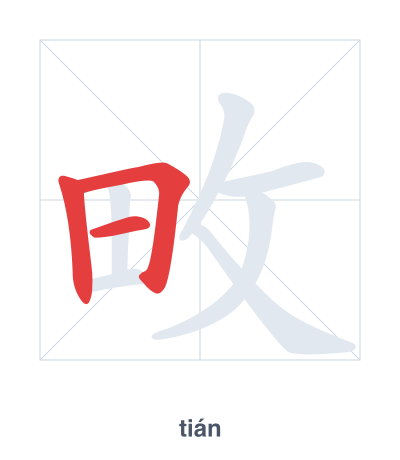
Open Hanzi Writer to see the animated stroke order and practice writing 畋 with real-time feedback.
The character 畋 (tián) is written with 9 strokes. Follow the standard Chinese stroke order: top to bottom, left to right, outside before inside. The radical 田 is one of its key components.
Practice the correct stroke order with the Hanzi Writer app to see animated stroke-by-stroke guidance with real-time feedback.
畋 means To hunt / To farm.
畋 combines 田 (field) with 攵 (a hand holding a stick or weapon), originally depicting someone hunting animals in the fields or working the land. Over time, the character came to represent both hunting and farming, as both activities involve actively managing the field.
💡 Memory Tip: Imagine a hand (攵) swinging a club across a field (田)—you're either hunting a wild boar or tilling the soil.
古人喜欢畋猎。
gǔ rén xǐ huān tián liè
Ancient people enjoyed hunting.
他以畋食为生。
tā yǐ tián shí wéi shēng
He makes a living by hunting.
畋渔之利甚厚。
tián yú zhī lì shèn hòu
The profits from hunting and fishing are very substantial.
Open Hanzi Writer to see the animated stroke order and practice writing 畋 with real-time feedback.
✨ Animated stroke order · Handwriting recognition · HSK-graded practice · Free to use
畋 is composed of the radical 田 (field) on the left and the component 攵 (a hand holding a stick or tapping) on the right. The 田 suggests farming or open land, while 攵 implies an action, so together they represent activities done in the fields: hunting or farming.