孝 (xiào) means "filial piety" in Chinese. It has 7 strokes with the radical 子, and is HSK Level 7.
Rated 3.5/5 in difficulty (challenging).
Harder than 17% of HSK Level 7 characters.
Appears in 3+ common words including 孝顺 (xiào shùn), 孝心 (xiào xīn), 尽孝 (jìn xiào).
Due to its 7 strokes, Hanzi Writer's error detection shows 孝 requires focused practice — most learners need 10+ attempts for consistent accuracy.
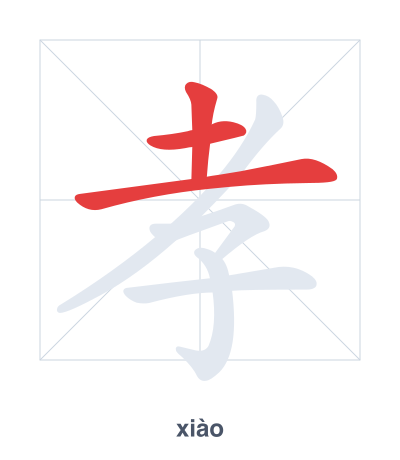
Open Hanzi Writer to see the animated stroke order and practice writing 孝 with real-time feedback.
The character 孝 (xiào) is written with 7 strokes. Follow the standard Chinese stroke order: top to bottom, left to right, outside before inside. The radical 子 is one of its key components.
Practice the correct stroke order with the Hanzi Writer app to see animated stroke-by-stroke guidance with real-time feedback.
孝 means filial piety.
As an HSK Level 7 character, 孝 is an intermediate-level character.
孝 combines a simplified form of 老 (old person) on top and 子 (child) below, depicting a child carrying or supporting an elderly parent. This directly illustrates the core meaning of filial piety—respect and care for one's elders.
💡 Memory Tip: Picture the top part as a hunched old person leaning on the child (子) below, symbolizing the child's duty to support them.
这个孩子非常孝顺。
zhè ge hái zi fēi cháng xiào shùn
This child is very filial and devoted to their parents.
这是我的一点孝心。
zhè shì wǒ de yì diǎn xiào xīn
This is a small token of my filial piety.
我们要对父母尽孝。
wǒ men yào duì fù mǔ jìn xiào
We should show filial piety to our parents.
Open Hanzi Writer to see the animated stroke order and practice writing 孝 with real-time feedback.
✨ Animated stroke order · Handwriting recognition · HSK-graded practice · Free to use
孝 is made of two parts: the top part 耂 (a variant meaning 'old person') and the bottom part 子 (child). This composition shows a child supporting an elderly person, directly reflecting the meaning of filial piety.