擿 (tī) means "To pick out; to expose" in Chinese. It has 17 strokes with the radical 扌.
Rated 4.2/5 in difficulty (advanced).
Appears in 3+ common words including 擿抉 (tī jué), 擿发 (tī fā), 擿伏 (tī fú).
Due to its 17 strokes, Hanzi Writer's error detection shows 擿 requires focused practice — most learners need 10+ attempts for consistent accuracy.
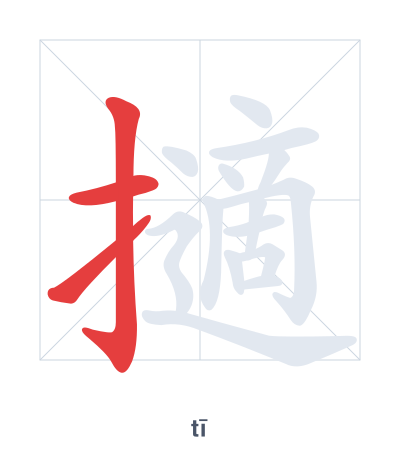
Open Hanzi Writer to see the animated stroke order and practice writing 擿 with real-time feedback.
The character 擿 (tī) is written with 17 strokes. Follow the standard Chinese stroke order: top to bottom, left to right, outside before inside. The radical 扌 is one of its key components.
Practice the correct stroke order with the Hanzi Writer app to see animated stroke-by-stroke guidance with real-time feedback.
擿 means To pick out; to expose.
The character 擿 is a compound combining the hand radical 扌 (hand) with a phonetic component 適 (shì), though the pronunciation shifted to tī. It originally meant to pick out or remove something, like using the hand to expose a hidden object. The right side 適 also vaguely suggests the idea of going toward or selecting, reinforcing the sense of extraction.
💡 Memory Tip: Picture your hand (扌) picking a tiny 'seed' (the shape inside 適) out of a crack, exposing it to light.
老师擿抉出课文重点。
lǎo shī tī jué chū kè wén zhòng diǎn
The teacher selected the key points of the text.
他擿发了那个秘密。
tā tī fā le nà ge mì mì
He exposed that secret.
警察擿伏了坏人。
jǐng chá tī fú le huài rén
The police exposed the villain's crimes.
Open Hanzi Writer to see the animated stroke order and practice writing 擿 with real-time feedback.
✨ Animated stroke order · Handwriting recognition · HSK-graded practice · Free to use
擿 is made of the radical 扌 (hand) on the left, and the phonetic component 適 (shì) on the right. The hand radical shows the action is done with hands, while 適 hints at the sound and the idea of reaching or selecting, so together they mean to pick out or expose.