酞 (tài) means "phthalein" in Chinese. It has 11 strokes with the radical 酉.
Rated 4.2/5 in difficulty (advanced).
Appears in 3+ common words including 酚酞 (fēn tài), 酞酸 (tài suān), 酞菁 (tài jīng).
Due to its 11 strokes, Hanzi Writer's error detection shows 酞 requires focused practice — most learners need 10+ attempts for consistent accuracy.
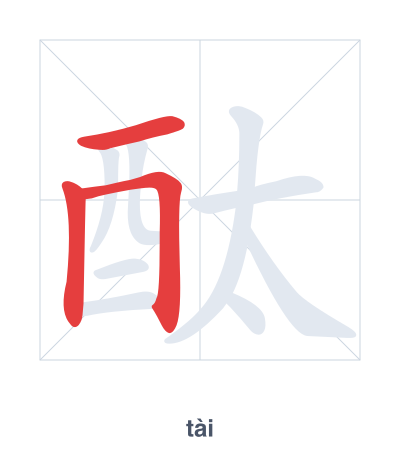
Open Hanzi Writer to see the animated stroke order and practice writing 酞 with real-time feedback.
The character 酞 (tài) is written with 11 strokes. Follow the standard Chinese stroke order: top to bottom, left to right, outside before inside. The radical 酉 is one of its key components.
Practice the correct stroke order with the Hanzi Writer app to see animated stroke-by-stroke guidance with real-time feedback.
酞 means phthalein.
酞 is a modern phono-semantic compound. The left radical 酉 (wine jar) acts as a semantic marker for chemical or fermented substances, while the right component 太 provides the pronunciation tài. Together they denote phthalein, a class of chemical compounds used in dyes and pH indicators.
💡 Memory Tip: Imagine a wine jar (酉) with a giant 'T' (太) on it, bubbling with a bright pink phthalein indicator that's too (太) vivid to ignore.
酚酞遇碱变红。
fēn tài yù jiǎn biàn hóng
Phenolphthalein turns red in the presence of alkali.
酞酸用于工业。
tài suān yòng yú gōng yè
Phthalic acid is used in industry.
酞菁是一种颜料。
tài jīng shì yī zhǒng yán liào
Phthalocyanine is a type of pigment.
Open Hanzi Writer to see the animated stroke order and practice writing 酞 with real-time feedback.
✨ Animated stroke order · Handwriting recognition · HSK-graded practice · Free to use
The character 酞 has two parts: the left radical 酉 (yǒu), meaning wine jar, and the right component 太 (tài), which gives pronunciation. In modern chemistry, 酉 is used in many characters for chemicals or compounds, so 酞 fits as a term for phthalein substances.