榫 (sǔn) means "Tenon" in Chinese. It has 14 strokes with the radical 木.
Rated 4.2/5 in difficulty (advanced).
Appears in 3+ common words including 榫头 (sǔn tou), 榫卯 (sǔn mǎo), 榫眼 (sǔn yǎn).
Due to its 14 strokes, Hanzi Writer's error detection shows 榫 requires focused practice — most learners need 10+ attempts for consistent accuracy.
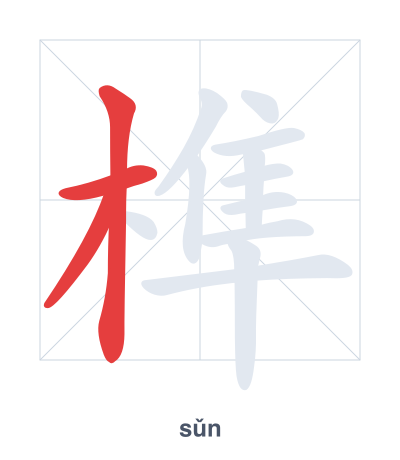
Open Hanzi Writer to see the animated stroke order and practice writing 榫 with real-time feedback.
The character 榫 (sǔn) is written with 14 strokes. Follow the standard Chinese stroke order: top to bottom, left to right, outside before inside. The radical 木 is one of its key components.
Practice the correct stroke order with the Hanzi Writer app to see animated stroke-by-stroke guidance with real-time feedback.
榫 means Tenon.
榫 is a phono-semantic compound: the radical 木 (wood) indicates it relates to woodworking, while the right side 隼 (sǔn, falcon) provides the pronunciation and also hints at the shape—a tenon juts out like a falcon’s beak, ready to fit into a mortise.
💡 Memory Tip: Picture a falcon (隼) with a pointed beak biting into a wooden plank (木) to form a perfect tenon joint.
榫头坏了。
sǔn tou huài le
The tenon is broken.
这是榫卯结构。
zhè shì sǔn mǎo jié gòu
This is a mortise and tenon structure.
找准榫眼。
zhǎo zhǔn sǔn yǎn
Locate the mortise accurately.
Open Hanzi Writer to see the animated stroke order and practice writing 榫 with real-time feedback.
✨ Animated stroke order · Handwriting recognition · HSK-graded practice · Free to use
The character 榫 is made of two parts: the radical 木 on the left means 'wood', and the right part 隼 (sǔn) gives the sound. Together, they suggest a wooden part that fits into another, which is exactly what a tenon does in joinery.