燧 (suì) means "Flint / Fire-making tool" in Chinese. It has 16 strokes with the radical 火.
Rated 4.2/5 in difficulty (advanced).
Appears in 3+ common words including 燧石 (suì shí), 燧人氏 (suì rén shì), 烽燧 (fēng suì).
Due to its 16 strokes, Hanzi Writer's error detection shows 燧 requires focused practice — most learners need 10+ attempts for consistent accuracy.
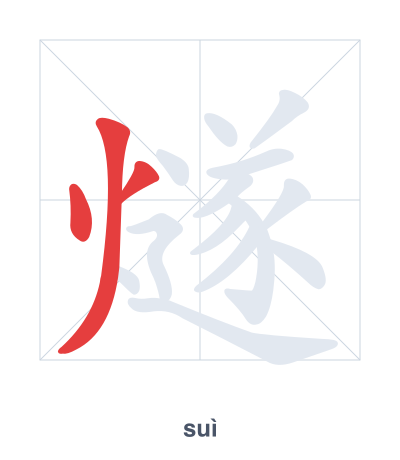
Open Hanzi Writer to see the animated stroke order and practice writing 燧 with real-time feedback.
The character 燧 (suì) is written with 16 strokes. Follow the standard Chinese stroke order: top to bottom, left to right, outside before inside. The radical 火 is one of its key components.
Practice the correct stroke order with the Hanzi Writer app to see animated stroke-by-stroke guidance with real-time feedback.
燧 means Flint / Fire-making tool.
燧 is a phono-semantic compound where 火 (fire) on the left indicates the meaning of fire-making, and 遂 (suì) on the right provides the pronunciation. In ancient China, a 燧 was a fire-drill or flint used to create sparks, often associated with the legendary figure Suiren (燧人), who taught people to make fire.
💡 Memory Tip: Imagine a spark (火) shooting out from a flint as it 'sweep' (遂) across a stone to ignite a fire.
燧石可以用来取火。
suì shí kě yǐ yòng lái qǔ huǒ
Flint can be used to start a fire.
燧人氏发明了取火。
suì rén shì fā míng le qǔ huǒ
Suiren invented the method of making fire.
古代用烽燧传信号。
gǔ dài yòng fēng suì chuán xìn hào
Ancient times used beacon towers to send signals.
Open Hanzi Writer to see the animated stroke order and practice writing 燧 with real-time feedback.
✨ Animated stroke order · Handwriting recognition · HSK-graded practice · Free to use
燧 is a left-right structure. The left radical is 火 (fire), which directly relates to its meaning of fire-making or flint. The right part is 遂 (suì), which provides the pronunciation and also hints at the action of 'following through' to create a spark.