绥 (suí) means "To pacify; to soothe; carriage strap" in Chinese. It has 10 strokes with the radical 纟.
Rated 4.2/5 in difficulty (advanced).
Appears in 3+ common words including 绥靖 (suí jìng), 绥远 (suí yuǎn), 抚绥 (fǔ suí).
Due to its 10 strokes, Hanzi Writer's error detection shows 绥 requires focused practice — most learners need 10+ attempts for consistent accuracy.
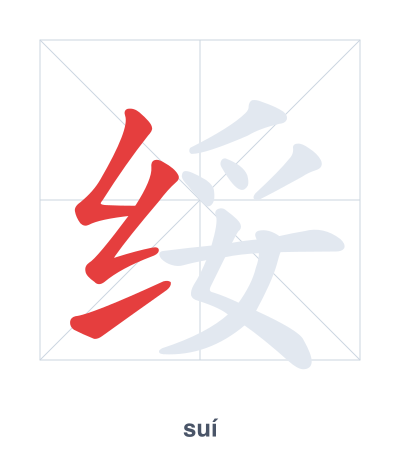
Open Hanzi Writer to see the animated stroke order and practice writing 绥 with real-time feedback.
The character 绥 (suí) is written with 10 strokes. Follow the standard Chinese stroke order: top to bottom, left to right, outside before inside. The radical 纟 is one of its key components.
Practice the correct stroke order with the Hanzi Writer app to see animated stroke-by-stroke guidance with real-time feedback.
绥 means To pacify; to soothe; carriage strap.
绥 combines the silk radical (纟) with 妥, meaning 'to settle' or 'secure'. Originally it depicted a carriage strap made of silk used to steady oneself, which evolved into the meanings of pacifying or soothing someone, like calming a restless passenger.
💡 Memory Tip: Picture a silk ribbon (纟) used to tie down a stubborn, anxious person (妥) so they finally settle down—that's pacification.
这是绥靖政策。
zhè shì suí jìng zhèng cè
This is the policy of appeasement.
他出生在绥远。
tā chū shēng zài suí yuǎn
He was born in Suiyuan.
官员在抚绥百姓。
guān yuán zài fǔ suí bǎi xìng
The official is comforting and pacifying the people.
Open Hanzi Writer to see the animated stroke order and practice writing 绥 with real-time feedback.
✨ Animated stroke order · Handwriting recognition · HSK-graded practice · Free to use
绥 is made of the radical 纟 (silk thread) on the left and the component 妥 (tuǒ, meaning 'proper' or 'to settle') on the right. Silk thread is used to bind or tie, and 妥 suggests settling something down. Together, they create the idea of soothing or pacifying by gently tying or calming.