绁 (xiè) means "to tie, to bind, leash" in Chinese. It has 8 strokes with the radical 纟.
Rated 3.7/5 in difficulty (challenging).
Appears in 3+ common words including 绁系 (xiè xì), 羁绁 (jī xiè), 绁绊 (xiè bàn).
Due to its 8 strokes, Hanzi Writer's error detection shows 绁 requires focused practice — most learners need 10+ attempts for consistent accuracy.
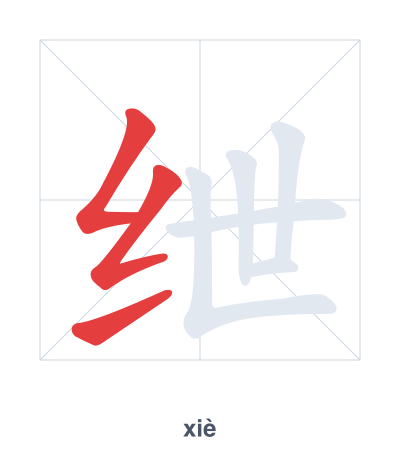
Open Hanzi Writer to see the animated stroke order and practice writing 绁 with real-time feedback.
The character 绁 (xiè) is written with 8 strokes. Follow the standard Chinese stroke order: top to bottom, left to right, outside before inside. The radical 纟 is one of its key components.
Practice the correct stroke order with the Hanzi Writer app to see animated stroke-by-stroke guidance with real-time feedback.
绁 means to tie, to bind, leash.
绁 is a phono-semantic compound. The left side 纟 (silk thread) indicates the meaning of tying or binding, while the right side 世 (shì) provides the pronunciation. Ancient Chinese used silk cords as leashes or bindings, so the character visually combines thread with a phonetic element.
💡 Memory Tip: Imagine a silken leash (纟) wrapped around the world (世), tying it up tight.
船被绳索绁系着。
chuán bèi shéng suǒ xiè xì zhe
The ship is tied up with ropes.
他不想受羁绁。
tā bù xiǎng shòu jī xiè
He doesn't want to be restrained.
别被琐事绁绊。
bié bèi suǒ shì xiè bàn
Don't be tied down by trifles.
Open Hanzi Writer to see the animated stroke order and practice writing 绁 with real-time feedback.
✨ Animated stroke order · Handwriting recognition · HSK-graded practice · Free to use
The character 绁 is made of the radical 纟 (silk thread) on the left and the component 世 (world) on the right. The silk radical suggests something related to threads or binding, and together with 世 it creates the meaning of tying or binding something.