睢 (suī) means "To look; Sui (a surname or place name)." in Chinese. It has 13 strokes with the radical 目.
Rated 4.2/5 in difficulty (advanced).
Appears in 3+ common words including 恣睢 (zì suī), 睢县 (suī xiàn), 睢睢 (suī suī).
Due to its 13 strokes, Hanzi Writer's error detection shows 睢 requires focused practice — most learners need 10+ attempts for consistent accuracy.
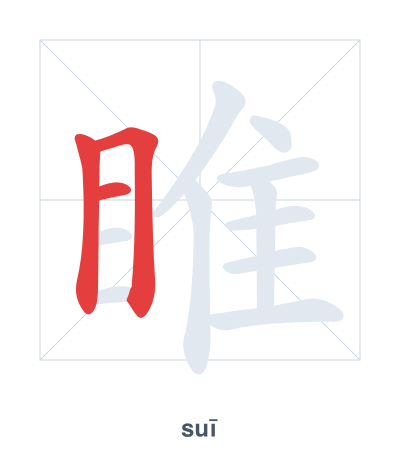
Open Hanzi Writer to see the animated stroke order and practice writing 睢 with real-time feedback.
The character 睢 (suī) is written with 13 strokes. Follow the standard Chinese stroke order: top to bottom, left to right, outside before inside. The radical 目 is one of its key components.
Practice the correct stroke order with the Hanzi Writer app to see animated stroke-by-stroke guidance with real-time feedback.
睢 means To look; Sui (a surname or place name)..
睢 combines the radical '目' (eye) with '隹' (short-tailed bird), suggesting the action of looking intently, as if watching a bird. It originally referred to a state or place name in ancient China and later extended to mean 'to look' or 'to gaze.'
💡 Memory Tip: A bird (隹) flies right in front of your eye (目), forcing you to look up suddenly.
他为人暴戾恣睢。
tā wéi rén bào lì zì suī
He is violent and tyrannical.
睢县在河南。
suī xiàn zài hé nán
Sui County is in Henan.
众人睢睢。
zhòng rén suī suī
Everyone is staring in amazement.
Open Hanzi Writer to see the animated stroke order and practice writing 睢 with real-time feedback.
✨ Animated stroke order · Handwriting recognition · HSK-graded practice · Free to use
睢 is composed of the radical 目 (eye) on the left and 隹 (short-tailed bird) on the right. The eye radical indicates that the character relates to seeing or looking, while 隹 provides a clue to the pronunciation suī.