濉 (suī) means "Sui (name of a river)" in Chinese. It has 16 strokes with the radical 氵.
Rated 4.2/5 in difficulty (advanced).
Appears in 3+ common words including 濉溪 (suī xī), 濉河 (suī hé), 濉宁 (suī níng).
Due to its 16 strokes, Hanzi Writer's error detection shows 濉 requires focused practice — most learners need 10+ attempts for consistent accuracy.
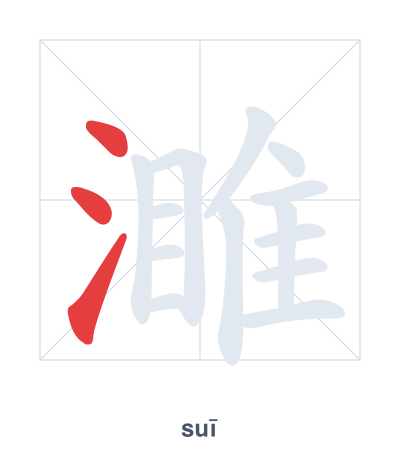
Open Hanzi Writer to see the animated stroke order and practice writing 濉 with real-time feedback.
The character 濉 (suī) is written with 16 strokes. Follow the standard Chinese stroke order: top to bottom, left to right, outside before inside. The radical 氵 is one of its key components.
Practice the correct stroke order with the Hanzi Writer app to see animated stroke-by-stroke guidance with real-time feedback.
濉 means Sui (name of a river).
濉 is a phono-semantic compound. The left radical 氵 (water) indicates the character relates to a river, while the right component 雖 (suī) provides the pronunciation. This structure tells us that 濉 is the name of a specific river in China, the Sui River.
💡 Memory Tip: Picture a river (氵) where a lazy lizard (虫) with an open mouth (口) floats along, singing 'Sui-Sui' as it names the Sui River.
他现在住在濉溪。
tā xiàn zài zhù zài suī xī
He lives in Suixi now.
濉河就在公园前面。
suī hé jiù zài gōng yuán qián miàn
The Sui River is right in front of the park.
濉宁是一个小县城。
suī níng shì yí gè xiǎo xiàn chéng
Suining is a small county town.
Open Hanzi Writer to see the animated stroke order and practice writing 濉 with real-time feedback.
✨ Animated stroke order · Handwriting recognition · HSK-graded practice · Free to use
The left side 氵 is the water radical, showing that 濉 relates to a river. The right side combines 隹 (a bird) and 冫 (ice), which together give the pronunciation suī but do not add to the meaning. So the water radical tells you it is the name of a river.