蔌 (sù) means "Vegetables" in Chinese. It has 14 strokes with the radical 艹.
Rated 4.2/5 in difficulty (advanced).
Appears in 3+ common words including 菜蔌 (cài sù), 蔌蔌 (sù sù), 肴蔌 (yáo sù).
Due to its 14 strokes, Hanzi Writer's error detection shows 蔌 requires focused practice — most learners need 10+ attempts for consistent accuracy.
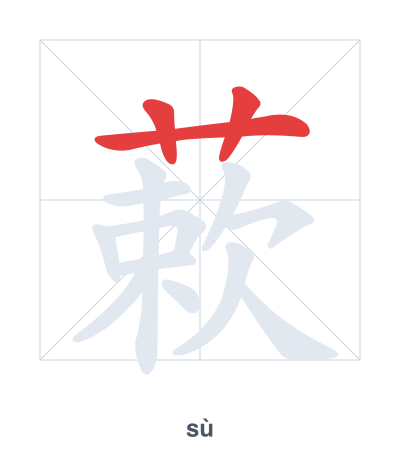
Open Hanzi Writer to see the animated stroke order and practice writing 蔌 with real-time feedback.
The character 蔌 (sù) is written with 14 strokes. Follow the standard Chinese stroke order: top to bottom, left to right, outside before inside. The radical 艹 is one of its key components.
Practice the correct stroke order with the Hanzi Writer app to see animated stroke-by-stroke guidance with real-time feedback.
蔌 means Vegetables.
蔌 combines the radical 艹 (grass/plants) with 束 (to bundle), suggesting vegetables tied together in a bunch. The character originally referred to bundled greens or edible plants, visually reinforced by the grass radical above the bundled shape.
💡 Memory Tip: Imagine a bundle of fresh vegetables (束) tied with a grass twine (艹) under the sun.
这里的菜蔌很新鲜。
zhè lǐ de cài sù hěn xīn xiān
The vegetables here are very fresh.
泪珠蔌蔌地流下来。
lèi zhū sù sù dì liú xià lái
Tears streamed down.
桌上摆满了肴蔌。
zhuō shàng bǎi mǎn le yáo sù
The table is full of meat and vegetable dishes.
Open Hanzi Writer to see the animated stroke order and practice writing 蔌 with real-time feedback.
✨ Animated stroke order · Handwriting recognition · HSK-graded practice · Free to use
蔌 is made of the radical 艹 (grass/plant) on top and 束 (bundle/tie) below. The 艹 radical suggests it is related to plants or vegetables, while 束 hints at the idea of gathered produce. Together, they represent vegetables as bundled or collected plants.