瞍 (sǒu) means "Blind" in Chinese. It has 14 strokes with the radical 目.
Rated 4.2/5 in difficulty (advanced).
Appears in 3+ common words including 盲瞍 (máng sǒu), 瞍者 (sǒu zhě), 瞍子 (sǒu zi).
Due to its 14 strokes, Hanzi Writer's error detection shows 瞍 requires focused practice — most learners need 10+ attempts for consistent accuracy.
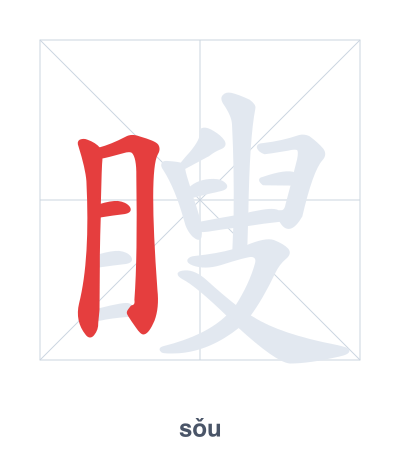
Open Hanzi Writer to see the animated stroke order and practice writing 瞍 with real-time feedback.
The character 瞍 (sǒu) is written with 14 strokes. Follow the standard Chinese stroke order: top to bottom, left to right, outside before inside. The radical 目 is one of its key components.
Practice the correct stroke order with the Hanzi Writer app to see animated stroke-by-stroke guidance with real-time feedback.
瞍 means Blind.
This phono-semantic compound combines the radical 目 (eye) with the phonetic component 叟 (sǒu, meaning 'old man'). The meaning 'blind' arises from the association of old age with failing eyesight, as 叟 evokes an elderly person who has lost their vision.
💡 Memory Tip: Picture an old man (叟) with a huge eye (目) on his face, but the eye is completely white and sightless—he is blind.
那个老人是盲瞍。
nà ge lǎo rén shì máng sǒu
That old man is blind.
瞍者看不见东西。
sǒu zhě kàn bú jiàn dōng xī
Blind people cannot see things.
他是一个瞍子。
tā shì yí gè sǒu zi
He is a blind person.
Open Hanzi Writer to see the animated stroke order and practice writing 瞍 with real-time feedback.
✨ Animated stroke order · Handwriting recognition · HSK-graded practice · Free to use
The character 瞍 is composed of the radical 目 (eye) on the left, which relates to sight, and the phonetic component 叟 (sǒu) on the right. The radical 目 gives the meaning of "eye," and together with the sound component, it forms the word for "blind." This structure is common for characters related to vision.