摅 (shū) means "express / vent" in Chinese. It has 13 strokes with the radical 扌.
Rated 4.2/5 in difficulty (advanced).
Appears in 3+ common words including 摅发 (shū fā), 摅怀 (shū huái), 摅诚 (shū chéng).
Due to its 13 strokes, Hanzi Writer's error detection shows 摅 requires focused practice — most learners need 10+ attempts for consistent accuracy.
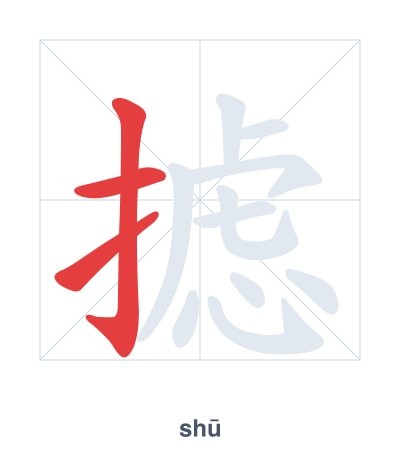
Open Hanzi Writer to see the animated stroke order and practice writing 摅 with real-time feedback.
The character 摅 (shū) is written with 13 strokes. Follow the standard Chinese stroke order: top to bottom, left to right, outside before inside. The radical 扌 is one of its key components.
Practice the correct stroke order with the Hanzi Writer app to see animated stroke-by-stroke guidance with real-time feedback.
摅 means express / vent.
The character 摅 combines the hand radical 扌 (indicating an action) with 虑 (lǜ, meaning 'to consider' or 'think'), suggesting the idea of using one's hands to let out or express thoughts—like writing or gesturing to vent feelings. This compound structure visually connects the physical action of the hand with the mental process of deliberation, forming the meaning 'express' or 'vent.'
💡 Memory Tip: Imagine a hand (扌) grabbing a tiger (虍) and shaking it violently to vent frustration, with the 'heart' (心) below adding emotion—a dramatic release.
他摅发了自己的感情。
tā shū fā le zì jǐ de gǎn qíng
He expressed his feelings.
诗人摅怀感叹。
shī rén shū huái gǎn tàn
The poet expressed his feelings and sighed.
我向你摅诚相告。
wǒ xiàng nǐ shū chéng xiāng gào
I am telling you this with total sincerity.
Open Hanzi Writer to see the animated stroke order and practice writing 摅 with real-time feedback.
✨ Animated stroke order · Handwriting recognition · HSK-graded practice · Free to use
摅 is made of the hand radical 扌 (shǒu) on the left, and the phonetic component 卢 (lú) on the right. The hand radical suggests using one's hand to express or vent emotions, such as writing or gesturing. The right side provides the pronunciation shū.