莳 (shí) means "to plant; to cultivate; dill" in Chinese. It has 10 strokes with the radical 艹.
Rated 4.2/5 in difficulty (advanced).
Appears in 3+ common words including 莳萝 (shí luó), 莳植 (shí zhí), 莳养 (shí yǎng).
Due to its 10 strokes, Hanzi Writer's error detection shows 莳 requires focused practice — most learners need 10+ attempts for consistent accuracy.
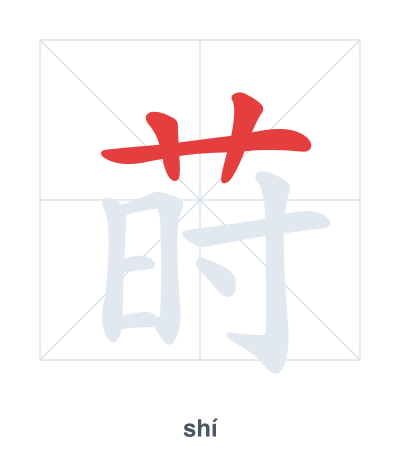
Open Hanzi Writer to see the animated stroke order and practice writing 莳 with real-time feedback.
The character 莳 (shí) is written with 10 strokes. Follow the standard Chinese stroke order: top to bottom, left to right, outside before inside. The radical 艹 is one of its key components.
Practice the correct stroke order with the Hanzi Writer app to see animated stroke-by-stroke guidance with real-time feedback.
莳 means to plant; to cultivate; dill.
莳 is a phono-semantic compound combining the grass radical 艹 (cǎo) with 时 (shí, 'time'), suggesting the action of transplanting or cultivating plants at the proper season. The character also refers to the herb dill, which is planted seasonally.
💡 Memory Tip: Imagine the grass (艹) growing steadily as time (时) passes, and you must plant your dill exactly when the sun and moon align.
莳萝可以做调料。
shí luó kě yǐ zuò tiáo liào
Dill can be used as a seasoning.
农民在莳植庄稼。
nóng mín zài shí zhí zhuāng jià
Farmers are planting crops.
这种花很难莳养。
zhè zhòng huā hěn nán shí yǎng
This flower is very difficult to cultivate.
Open Hanzi Writer to see the animated stroke order and practice writing 莳 with real-time feedback.
✨ Animated stroke order · Handwriting recognition · HSK-graded practice · Free to use
The top part is the grass radical (艹), showing the character relates to plants and vegetation. The bottom part is 时 (shí, meaning time), which may hint at planting according to seasons. Together, 莳 means to plant or cultivate.