埘 (shí) means "Henhouse; roost." in Chinese. It has 10 strokes with the radical 土.
Rated 4.2/5 in difficulty (advanced).
Appears in 3+ common words including 鸡埘 (jī shí), 鸟埘 (niǎo shí), 栖埘 (qī shí).
Due to its 10 strokes, Hanzi Writer's error detection shows 埘 requires focused practice — most learners need 10+ attempts for consistent accuracy.
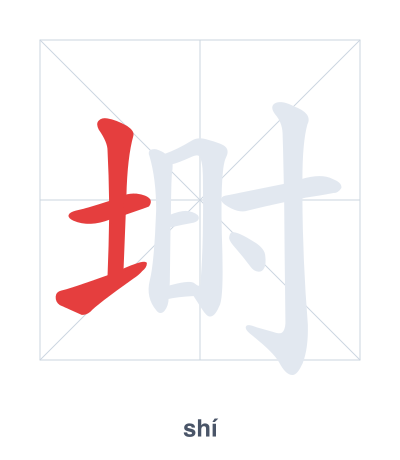
Open Hanzi Writer to see the animated stroke order and practice writing 埘 with real-time feedback.
The character 埘 (shí) is written with 10 strokes. Follow the standard Chinese stroke order: top to bottom, left to right, outside before inside. The radical 土 is one of its key components.
Practice the correct stroke order with the Hanzi Writer app to see animated stroke-by-stroke guidance with real-time feedback.
埘 means Henhouse; roost..
埘 is a phono-semantic compound: the radical 土 (earth) indicates a structure made of earth, while 时 (shí, originally meaning 'time') provides the phonetic hint. Together, they depict an earthen enclosure where chickens roost at a set time of day.
💡 Memory Tip: Picture a henhouse built from a pile of dirt (土) with a clock (时) on top, reminding you that chickens return there at roosting time.
鸡回到了鸡埘。
jī huí dào le jī shí
The chicken returned to the coop.
鸟儿在鸟埘里。
niǎo ér zài niǎo shí lǐ
The bird is in its coop.
它们在这里栖埘。
tā men zài zhè lǐ qī shí
They roost here.
Open Hanzi Writer to see the animated stroke order and practice writing 埘 with real-time feedback.
✨ Animated stroke order · Handwriting recognition · HSK-graded practice · Free to use
埘 is a left-right character. The left part 土 means 'earth' or 'ground', and the right part 时 (shí) gives the pronunciation. Together they suggest a ground-level structure for birds to roost, as henhouses were often built with earth.