蜃 (shèn) means "Large clam / Sea monster" in Chinese. It has 13 strokes with the radical 虫.
Rated 4.2/5 in difficulty (advanced).
Appears in 3+ common words including 海市蜃楼 (hǎi shì shèn lóu), 蜃景 (shèn jǐng), 蜃气 (shèn qì).
Due to its 13 strokes, Hanzi Writer's error detection shows 蜃 requires focused practice — most learners need 10+ attempts for consistent accuracy.
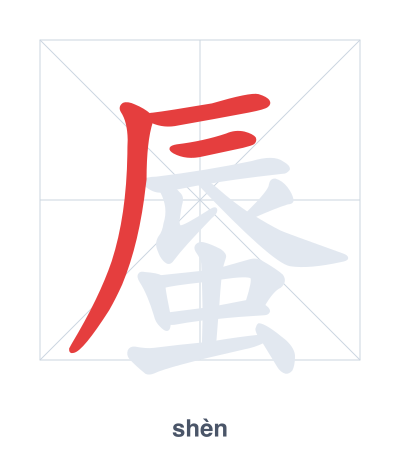
Open Hanzi Writer to see the animated stroke order and practice writing 蜃 with real-time feedback.
The character 蜃 (shèn) is written with 13 strokes. Follow the standard Chinese stroke order: top to bottom, left to right, outside before inside. The radical 虫 is one of its key components.
Practice the correct stroke order with the Hanzi Writer app to see animated stroke-by-stroke guidance with real-time feedback.
蜃 means Large clam / Sea monster.
蜃 combines the radical 虫 (shellfish) with 辰, which originally depicted a large clamshell. Together they form a compound that means a giant clam or the mythical sea monster believed to create mirages.
💡 Memory Tip: Picture a giant clam (虫) sitting on a throne (辰) blowing out a shimmering mirage of a sea monster.
我看到了海市蜃楼。
wǒ kàn dào le hǎi shì shèn lóu
I saw a mirage.
这是一个奇特的蜃景。
zhè shì yí gè qí tè de shèn jǐng
This is a peculiar mirage.
蜃气形成了幻象。
shèn qì xíng chéng le huàn xiàng
The sea-mist created an illusion.
Open Hanzi Writer to see the animated stroke order and practice writing 蜃 with real-time feedback.
✨ Animated stroke order · Handwriting recognition · HSK-graded practice · Free to use
蜃 is composed of 辰 on top and 虫 below. 虫 (insect/worm) suggests a creature, while 辰 may relate to time or the dawn, but here it likely indicates a large clam or sea monster that appears in myths. Together, the character evokes a mythical creature associated with the sea.