诜 (shēn) means "numerous (literary)" in Chinese. It has 8 strokes with the radical 讠.
Rated 3.4/5 in difficulty (challenging).
Appears in 2+ common words including 诜诜 (shēn shēn), 诜 (shēn).
Due to its 8 strokes, Hanzi Writer's error detection shows 诜 requires focused practice — most learners need 10+ attempts for consistent accuracy.
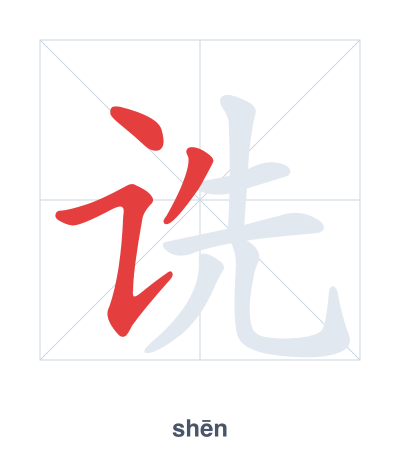
Open Hanzi Writer to see the animated stroke order and practice writing 诜 with real-time feedback.
The character 诜 (shēn) is written with 8 strokes. Follow the standard Chinese stroke order: top to bottom, left to right, outside before inside. The radical 讠 is one of its key components.
Practice the correct stroke order with the Hanzi Writer app to see animated stroke-by-stroke guidance with real-time feedback.
诜 means numerous (literary).
诜 is a phono-semantic compound where the radical 讠 (speech) suggests the character relates to language, and 先 (xiān, 'first') provides the pronunciation shēn. The original meaning 'numerous' likely developed from classical texts where 诜 describes a multitude, such as in the phrase '诜诜' (abundant).
💡 Memory Tip: Imagine a crowd of people all shouting 'First!' (先) at the same time — the speech bubble (讠) overflows with their competing voices, showing 'numerous' speakers.
宾客诜诜。
bīn kè shēn shēn
The guests are numerous.
这是一个生僻字。
zhè shì yí gè shēng pì zì
This is a rare character.
他名字里有诜字。
tā míng zì lǐ yǒu shēn zì
His name contains the character 'Shen'.
Open Hanzi Writer to see the animated stroke order and practice writing 诜 with real-time feedback.
✨ Animated stroke order · Handwriting recognition · HSK-graded practice · Free to use
诜 consists of the radical 讠 (speech) on the left and 先 (xiān, meaning 'first' or 'before') on the right. The radical hints at spoken language, while 先 provides the pronunciation. The literary meaning 'numerous' is not directly formed by its parts, so it must be memorized as a whole.