娠 (shēn) means "pregnancy; to be pregnant" in Chinese. It has 10 strokes with the radical 女.
Rated 4.2/5 in difficulty (advanced).
Appears in 3+ common words including 妊娠 (rèn shēn), 妊娠期 (rèn shēn qī), 娠妇 (shēn fù).
Due to its 10 strokes, Hanzi Writer's error detection shows 娠 requires focused practice — most learners need 10+ attempts for consistent accuracy.
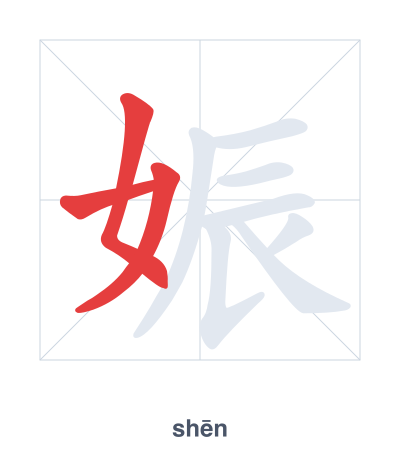
Open Hanzi Writer to see the animated stroke order and practice writing 娠 with real-time feedback.
The character 娠 (shēn) is written with 10 strokes. Follow the standard Chinese stroke order: top to bottom, left to right, outside before inside. The radical 女 is one of its key components.
Practice the correct stroke order with the Hanzi Writer app to see animated stroke-by-stroke guidance with real-time feedback.
娠 means pregnancy; to be pregnant.
This phono-semantic compound combines the radical 女 (woman) with phonetic 辰 (chén), which originally depicted a clam shell. The woman radical indicates the meaning of pregnancy, while 辰 provides pronunciation.
💡 Memory Tip: Picture a woman (女) carrying a large clamshell (辰) on her belly, symbolizing the growing weight of pregnancy.
医生在检查妊娠情况。
yī shēng zài jiǎn chá rèn shēn qíng kuàng
The doctor is checking the pregnancy status.
妊娠期要注意休息。
rèn shēn qī yào zhù yì xiū xī
One should rest during pregnancy.
娠妇需要补充营养。
shēn fù xū yào bǔ chōng yíng yǎng
Pregnant women need nutritional supplements.
Open Hanzi Writer to see the animated stroke order and practice writing 娠 with real-time feedback.
✨ Animated stroke order · Handwriting recognition · HSK-graded practice · Free to use
The character 娠 combines the radical 女 (woman) on the left with 辰 (shēn) on the right. 辰 serves as a phonetic component and also suggests the idea of movement or time, together implying a woman carrying a moving life inside — pregnancy.