剡 (shàn) means "to sharpen; to cut; Shan (place name)" in Chinese. It has 10 strokes with the radical 刂.
Rated 3.9/5 in difficulty (challenging).
Appears in 3+ common words including 剡溪 (shàn xī), 剡纸 (shàn zhǐ), 剡锋 (shàn fēng).
Due to its 10 strokes, Hanzi Writer's error detection shows 剡 requires focused practice — most learners need 10+ attempts for consistent accuracy.
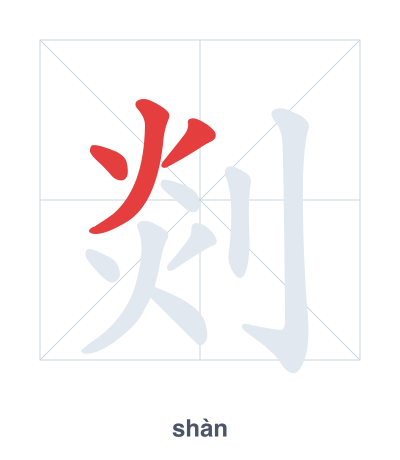
Open Hanzi Writer to see the animated stroke order and practice writing 剡 with real-time feedback.
The character 剡 (shàn) is written with 10 strokes. Follow the standard Chinese stroke order: top to bottom, left to right, outside before inside. The radical 刂 is one of its key components.
Practice the correct stroke order with the Hanzi Writer app to see animated stroke-by-stroke guidance with real-time feedback.
剡 means to sharpen; to cut; Shan (place name).
剡 is a phono-semantic compound. The left component 炎 (flame) provides a phonetic hint, while the right radical 刂 (knife) indicates the meaning of cutting or sharpening. Together, they evoke the image of a blade being forged or honed with fire.
💡 Memory Tip: Imagine a fiery knife (刂) glowing red-hot from the flames (炎) as it is sharpened with a cutting motion.
剡溪的风景很美。
shàn xī de fēng jǐng hěn měi
The scenery of Shan Stream is very beautiful.
这是著名的剡纸。
zhè shì zhù míng de shàn zhǐ
This is the famous Shan paper.
刀锋非常剡利。
dāo fēng fēi cháng shàn lì
The edge of the knife is extremely sharp.
Open Hanzi Writer to see the animated stroke order and practice writing 剡 with real-time feedback.
✨ Animated stroke order · Handwriting recognition · HSK-graded practice · Free to use
The character 剡 consists of 火 (fire) on top and 刂 (knife) on the bottom. The fire part suggests heating or tempering, while the knife radical indicates cutting, together implying the action of sharpening or cutting with heat.