蕤 (ruí) means "Drooping / Lush growth" in Chinese. It has 15 strokes with the radical 艹.
Rated 4.2/5 in difficulty (advanced).
Appears in 3+ common words including 葳蕤 (wēi ruí), 蕤宾 (ruí bīn), 冠蕤 (guān ruí).
Due to its 15 strokes, Hanzi Writer's error detection shows 蕤 requires focused practice — most learners need 10+ attempts for consistent accuracy.
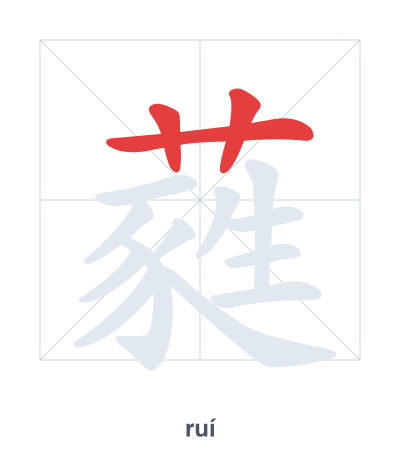
Open Hanzi Writer to see the animated stroke order and practice writing 蕤 with real-time feedback.
The character 蕤 (ruí) is written with 15 strokes. Follow the standard Chinese stroke order: top to bottom, left to right, outside before inside. The radical 艹 is one of its key components.
Practice the correct stroke order with the Hanzi Writer app to see animated stroke-by-stroke guidance with real-time feedback.
蕤 means Drooping / Lush growth.
蕤 is composed of the grass radical 艹 and the component 甤, which originally depicted hanging tassels or drooping vegetation. Together, they represent lush grass or leaves that bend downward under their own weight.
💡 Memory Tip: Imagine a clump of grass (艹) so thick and heavy that its leaves droop and form a tangled 'ruif' of greenery (甤 looking like a messy bundle).
花草长得很葳蕤。
huā cǎo zhǎng dé hěn wēi ruí
The flowers and plants are growing luxuriantly.
蕤宾是古代的音律。
ruí bīn shì gǔ dài de yīn lǜ
Ruibin is an ancient musical temperament.
他的帽子上有冠蕤。
tā de mào zi shàng yǒu guān ruí
There are tassels on his hat.
Open Hanzi Writer to see the animated stroke order and practice writing 蕤 with real-time feedback.
✨ Animated stroke order · Handwriting recognition · HSK-graded practice · Free to use
The character has the grass radical 艹 on top, indicating plants. Below is the component 㽔, which originally depicted hanging flower buds or tassels. Together, these parts suggest vegetation that is so lush it droops down.