葳 (wēi) means "luxuriant" in Chinese. It has 12 strokes with the radical 艹.
Rated 4.2/5 in difficulty (advanced).
Appears in 1+ common words including 葳蕤 (wēi ruí).
Due to its 12 strokes, Hanzi Writer's error detection shows 葳 requires focused practice — most learners need 10+ attempts for consistent accuracy.
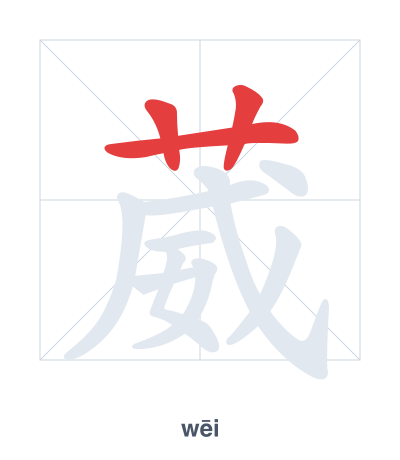
Open Hanzi Writer to see the animated stroke order and practice writing 葳 with real-time feedback.
The character 葳 (wēi) is written with 12 strokes. Follow the standard Chinese stroke order: top to bottom, left to right, outside before inside. The radical 艹 is one of its key components.
Practice the correct stroke order with the Hanzi Writer app to see animated stroke-by-stroke guidance with real-time feedback.
葳 means luxuriant.
葳 is a compound character with the grass radical (艹) indicating plants, and 威 (wēi, 'might' or 'power') providing the sound and hinting at vigorous growth. Together they depict luxuriant vegetation flourishing with overwhelming strength.
💡 Memory Tip: Picture a patch of grass (艹) so luxuriant that it completely engulfs a powerful (威) warrior's axe, making it invisible.
这里的草木葳蕤。
zhè lǐ de cǎo mù wēi ruí
The vegetation here is luxuriant.
枝叶十分葳蕤。
zhī yè shí fēn wēi ruí
The branches and leaves are very lush.
葳蕤的春天。
wēi ruí de chūn tiān
A flourishing spring.
Open Hanzi Writer to see the animated stroke order and practice writing 葳 with real-time feedback.
✨ Animated stroke order · Handwriting recognition · HSK-graded practice · Free to use
葳 is composed of the grass radical 艹 on top and the phonetic component 威 (wēi) below. The grass radical indicates that the character relates to plants or vegetation, while the sound component hints at its pronunciation. Together, they form a character meaning "luxuriant" or "flourishing," like dense, thriving grass.