蠕 (rú) means "To wriggle / To crawl" in Chinese. It has 20 strokes with the radical 虫.
Rated 4.2/5 in difficulty (advanced).
Appears in 3+ common words including 蠕动 (rú dòng), 蠕虫 (rú chóng), 蠕行 (rú xíng).
Due to its 20 strokes, Hanzi Writer's error detection shows 蠕 requires focused practice — most learners need 10+ attempts for consistent accuracy.
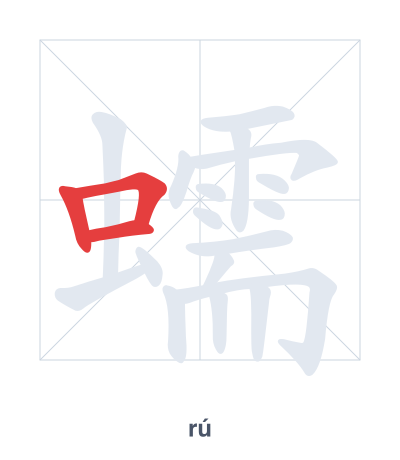
Open Hanzi Writer to see the animated stroke order and practice writing 蠕 with real-time feedback.
The character 蠕 (rú) is written with 20 strokes. Follow the standard Chinese stroke order: top to bottom, left to right, outside before inside. The radical 虫 is one of its key components.
Practice the correct stroke order with the Hanzi Writer app to see animated stroke-by-stroke guidance with real-time feedback.
蠕 means To wriggle / To crawl.
蠕 is a phono-semantic compound. The radical 虫 (insect) signals that the meaning relates to small crawling creatures, while 需 (rú) provides the pronunciation. Together, they depict the slow, wriggling movement of worms or insects.
💡 Memory Tip: Imagine a worm (虫) that 'needs' (需) to wriggle through muddy rain (the top part of 需 resembles rain 雨) to reach its destination.
虫子在蠕动。
chóng zi zài rú dòng
The worm is wriggling.
蠕虫在土里。
rú chóng zài tǔ lǐ
The worm is in the soil.
汽车在蠕行。
qì chē zài rú xíng
The car is crawling along.
Open Hanzi Writer to see the animated stroke order and practice writing 蠕 with real-time feedback.
✨ Animated stroke order · Handwriting recognition · HSK-graded practice · Free to use
The character 蠕 is made of the radical 虫 (insect) on the left, which indicates it relates to worms or crawling creatures. The right part 需 (need) gives a loose phonetic hint for the pronunciation rú. Together, the structure suggests a worm that moves by wriggling.