蟠 (pán) means "Coiled" in Chinese. It has 18 strokes with the radical 虫.
Rated 4.2/5 in difficulty (advanced).
Appears in 3+ common words including 蟠桃 (pán táo), 蟠龙 (pán lóng), 蟠曲 (pán qū).
Due to its 18 strokes, Hanzi Writer's error detection shows 蟠 requires focused practice — most learners need 10+ attempts for consistent accuracy.
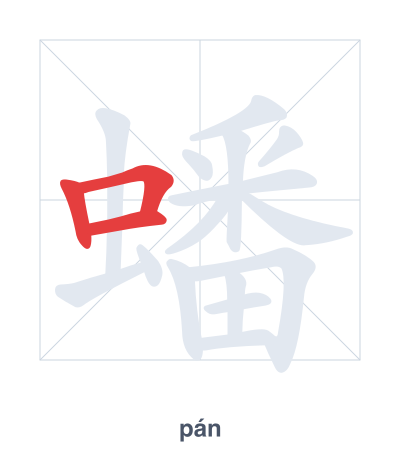
Open Hanzi Writer to see the animated stroke order and practice writing 蟠 with real-time feedback.
The character 蟠 (pán) is written with 18 strokes. Follow the standard Chinese stroke order: top to bottom, left to right, outside before inside. The radical 虫 is one of its key components.
Practice the correct stroke order with the Hanzi Writer app to see animated stroke-by-stroke guidance with real-time feedback.
蟠 means Coiled.
蟠 is a compound character with the radical 虫 (insect/reptile) and the phonetic component 番 (meaning 'to turn over' or 'alternate'). Together, they depict a creature—often a snake or dragon—that twists or coils itself into a spiral shape, reflecting the meaning 'coiled'.
💡 Memory Tip: Picture a serpent (虫) coiling around a spinning wheel (番) that twists tighter and tighter.
蟠桃的味道很好吃。
pán táo de wèi dào hěn hǎo chī
Flat peaches taste delicious.
柱子上有一条蟠龙。
zhù zi shàng yǒu yī tiáo pán lóng
There is a coiled dragon on the pillar.
小路在山间蟠曲。
xiǎo lù zài shān jiān pán qū
The path winds through the mountains.
Open Hanzi Writer to see the animated stroke order and practice writing 蟠 with real-time feedback.
✨ Animated stroke order · Handwriting recognition · HSK-graded practice · Free to use
蟠 has the radical 虫 (insect/worm) on the left, and the phonetic component 番 on the right. The worm radical suggests a twisting, crawling shape, while 番 means 'to turn over', together implying something coiled or winding, like a coiled dragon or twisted peach branch.