茹 (rú) means "to eat / to consume" in Chinese. It has 9 strokes with the radical 艹.
Rated 4/5 in difficulty (challenging).
Appears in 3+ common words including 茹素 (rú sù), 含辛茹苦 (hán xīn rú kǔ), 茹毛饮血 (rú máo yǐn xuè).
Due to its 9 strokes, Hanzi Writer's error detection shows 茹 requires focused practice — most learners need 10+ attempts for consistent accuracy.
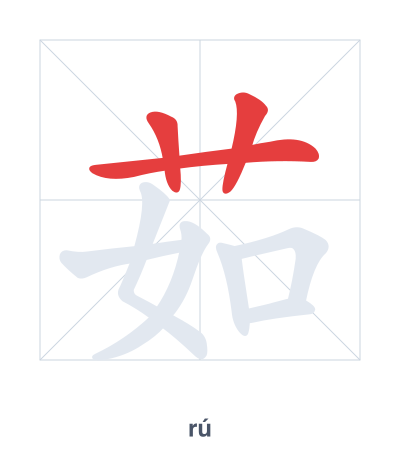
Open Hanzi Writer to see the animated stroke order and practice writing 茹 with real-time feedback.
The character 茹 (rú) is written with 9 strokes. Follow the standard Chinese stroke order: top to bottom, left to right, outside before inside. The radical 艹 is one of its key components.
Practice the correct stroke order with the Hanzi Writer app to see animated stroke-by-stroke guidance with real-time feedback.
茹 means to eat / to consume.
茹 is a phono-semantic compound where the grass radical 艹 indicates plants, and 如 (rú) provides the sound. It originally referred to animals or people eating grass or roots, later generalizing to mean 'to eat' or 'to consume.'
💡 Memory Tip: Picture a woman (女) opening her mouth (口) to eat a heap of grass (艹) above her head.
他为了健康决定茹素。
tā wèi le jiàn kāng jué dìng rú sù
He decided to go vegetarian for his health.
父母含辛茹苦养大我。
fù mǔ hán xīn rú kǔ yǎng dà wǒ
My parents endured all kinds of hardships to raise me.
原始人茹毛饮血。
yuán shǐ rén rú máo yǐn xuè
Primitive people lived a savage life (eating raw meat and drinking blood).
Open Hanzi Writer to see the animated stroke order and practice writing 茹 with real-time feedback.
✨ Animated stroke order · Handwriting recognition · HSK-graded practice · Free to use
茹 is made of the radical 艹 (grass) on top and 如 (rú, like/as) below. The grass radical hints at eating plants or vegetables, while 如 provides the pronunciation and the idea of 'going along with' consuming food.