仞 (rèn) means "ren (ancient unit of length, approx. 7-8 feet)" in Chinese. It has 5 strokes with the radical 亻.
Rated 2.7/5 in difficulty (moderate).
Appears in 3+ common words including 万仞 (wàn rèn), 仞度 (rèn dù), 壁立千仞 (bì lì qiān rèn).
Hanzi Writer's stroke validation shows learners typically need 5-8 attempts to write 仞 with correct proportion and order.
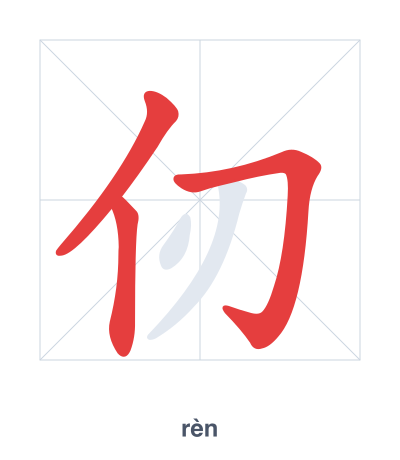
Open Hanzi Writer to see the animated stroke order and practice writing 仞 with real-time feedback.
The character 仞 (rèn) is written with 5 strokes. Follow the standard Chinese stroke order: top to bottom, left to right, outside before inside. The radical 亻 is one of its key components.
Practice the correct stroke order with the Hanzi Writer app to see animated stroke-by-stroke guidance with real-time feedback.
仞 means ren (ancient unit of length, approx. 7-8 feet).
仞 is a phono-semantic compound where 亻 (person) indicates a human-related measure, and 刃 (blade, also pronounced rèn) provides the phonetic hint. This unit of length (approx. 7-8 feet) originally derived from a person's outstretched arms or height, visually combining a person with a sharp edge to suggest a precise measurement.
💡 Memory Tip: Picture a person (亻) holding a blade (刃) exactly 7 feet off the ground to mark the ancient unit of length.
这座山有万仞高。
zhè zuò shān yǒu wàn rèn gāo
This mountain is incredibly high.
这里的深度有几仞?
zhè lǐ de shēn dù yǒu jǐ rèn
How many 'ren' (ancient units of depth) deep is it here?
悬崖壁立千仞。
xuán yá bì lì qiān rèn
The cliff stands thousands of feet high.
Open Hanzi Writer to see the animated stroke order and practice writing 仞 with real-time feedback.
✨ Animated stroke order · Handwriting recognition · HSK-graded practice · Free to use
仞 is made of two parts: the left radical 亻 (person) and the right part 刃 (blade). The person radical suggests this character is related to human activity, and 刃 provides the pronunciation (rèn). Together, they represent an ancient unit of length that people used to measure heights and depths.