逡 (qūn) means "to retreat" in Chinese. It has 10 strokes with the radical 辶.
Rated 4.2/5 in difficulty (advanced).
Appears in 3+ common words including 逡巡 (qūn xún), 逡避 (qūn bì), 逡改 (qūn gǎi).
Due to its 10 strokes, Hanzi Writer's error detection shows 逡 requires focused practice — most learners need 10+ attempts for consistent accuracy.
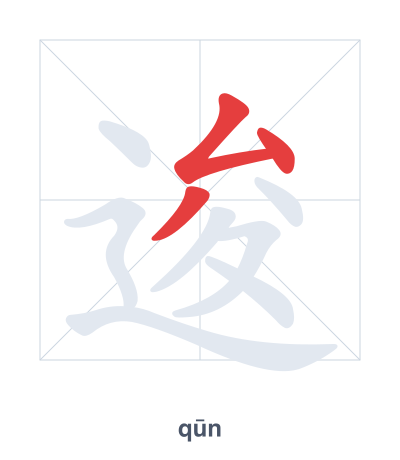
Open Hanzi Writer to see the animated stroke order and practice writing 逡 with real-time feedback.
The character 逡 (qūn) is written with 10 strokes. Follow the standard Chinese stroke order: top to bottom, left to right, outside before inside. The radical 辶 is one of its key components.
Practice the correct stroke order with the Hanzi Writer app to see animated stroke-by-stroke guidance with real-time feedback.
逡 means to retreat.
The character 逡 combines the radical 辶 (walking) with 夋 (shrink back, originally depicting a person bending down with a foot). Together, they convey the idea of moving backward or withdrawing.
💡 Memory Tip: Picture a person (允) walking (辶) but a foot (夂) pushes them back, forcing a retreat.
他在门口逡巡了很久。
tā zài mén kǒu qūn xún le hěn jiǔ
He paced around the door for a long time.
遇到危险要学会逡避。
yù dào wēi xiǎn yào xué huì qūn bì
Learn to avoid danger when you encounter it.
这个计划不能随便逡改。
zhè ge jì huà bù néng suí biàn qūn gǎi
This plan cannot be changed at will.
Open Hanzi Writer to see the animated stroke order and practice writing 逡 with real-time feedback.
✨ Animated stroke order · Handwriting recognition · HSK-graded practice · Free to use
逡 is made of the walking radical 辶 and the phonetic component 夋. The 辶 suggests movement, while 夋 gives the sound and a sense of retreating or hesitating. Together, the character shows the idea of moving backward or pausing in movement.