榷 (què) means "Monopoly or footbridge" in Chinese. It has 14 strokes with the radical 木.
Rated 4.2/5 in difficulty (advanced).
Appears in 3+ common words including 商榷 (shāng què), 榷场 (què chǎng), 榷税 (què shuì).
Due to its 14 strokes, Hanzi Writer's error detection shows 榷 requires focused practice — most learners need 10+ attempts for consistent accuracy.
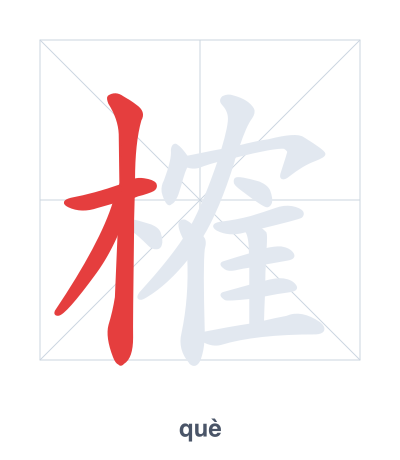
Open Hanzi Writer to see the animated stroke order and practice writing 榷 with real-time feedback.
The character 榷 (què) is written with 14 strokes. Follow the standard Chinese stroke order: top to bottom, left to right, outside before inside. The radical 木 is one of its key components.
Practice the correct stroke order with the Hanzi Writer app to see animated stroke-by-stroke guidance with real-time feedback.
榷 means Monopoly or footbridge.
榷 combines the radical 木 (wood/tree) with the phonetic component 隺 (hè, originally a bird or high). The character's ancient meaning was a single-log footbridge, narrow and exclusive, which later metaphorically extended to mean a monopoly—a sole control over trade, like a bridge that only one may cross.
💡 Memory Tip: Imagine a wooden (木) bridge that is so narrow it's like a tightrope for a crane (隺), and the crane charges a monopoly toll for anyone to cross.
这个问题值得商榷。
zhè ge wèn tí zhí de shāng què
This issue is open to debate.
古代有专门的榷场。
gǔ dài yǒu zhuān mén de què chǎng
Ancient times had specialized border trading posts.
榷税是古代的税收。
què shuì shì gǔ dài de shuì shōu
Que tax was an ancient form of taxation.
Open Hanzi Writer to see the animated stroke order and practice writing 榷 with real-time feedback.
✨ Animated stroke order · Handwriting recognition · HSK-graded practice · Free to use
榷 is made of the radical 木 (tree/wood) on the left, and the phonetic component 隺 on the right. The wood radical hints at the original meaning of a wooden footbridge, while the whole character is also used for monopoly because ancient monopolies often controlled goods like salt or timber.