荃 (quán) means "a fragrant plant (often used as a metaphor for a ruler in classical poetry)" in Chinese. It has 9 strokes with the radical 艹.
Rated 4/5 in difficulty (challenging).
Appears in 3+ common words including 荃蹄 (quán tí), 荃察 (quán chá), 荃不察 (quán bù chá).
Due to its 9 strokes, Hanzi Writer's error detection shows 荃 requires focused practice — most learners need 10+ attempts for consistent accuracy.
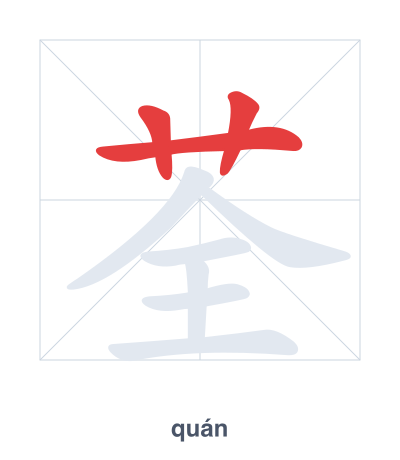
Open Hanzi Writer to see the animated stroke order and practice writing 荃 with real-time feedback.
The character 荃 (quán) is written with 9 strokes. Follow the standard Chinese stroke order: top to bottom, left to right, outside before inside. The radical 艹 is one of its key components.
Practice the correct stroke order with the Hanzi Writer app to see animated stroke-by-stroke guidance with real-time feedback.
荃 means a fragrant plant (often used as a metaphor for a ruler in classical poetry).
荃 combines the grass radical 艹 with 全 (quán, meaning 'complete' or 'pure'), suggesting a plant that is entirely fragrant or pure. In classical poetry, it metaphorically represents a virtuous ruler, emphasizing wholeness and moral purity.
💡 Memory Tip: Picture the 'king' (全) hiding under a patch of grass (艹) — this fragrant plant is so noble it could only represent a ruler.
荃蹄是捕鱼的工具。
quán tí shì bǔ yú de gōng jù
Quanti refers to tools used for fishing and hunting.
希望您能荃察。
xī wàng nín néng quán chá
I hope you can examine this thoroughly.
这是《离骚》里的词。
zhè shì lí sāo lǐ de cí
This is a word from the poem 'Li Sao'.
Open Hanzi Writer to see the animated stroke order and practice writing 荃 with real-time feedback.
✨ Animated stroke order · Handwriting recognition · HSK-graded practice · Free to use
荃 is a top-bottom structure with the radical 艹 (grass) on top and 全 (quán, complete) below. The grass radical indicates it is a type of plant, while the phonetic component 全 gives the sound "quán" and subtly suggests completeness or wholeness, matching the idea of a fragrant plant used to represent a ruler.