蕖 (qú) means "Lotus flower" in Chinese. It has 14 strokes with the radical 艹.
Rated 4.2/5 in difficulty (advanced).
Appears in 3+ common words including 芙蕖 (fú qú), 红蕖 (hóng qú), 采蕖 (cǎi qú).
Due to its 14 strokes, Hanzi Writer's error detection shows 蕖 requires focused practice — most learners need 10+ attempts for consistent accuracy.
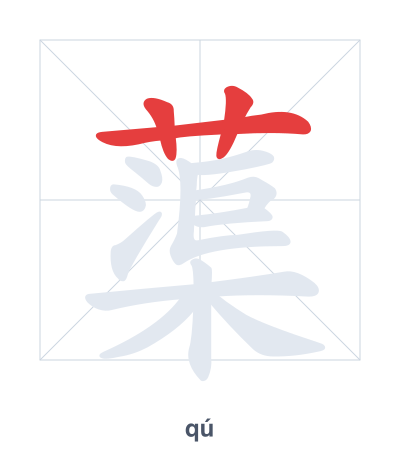
Open Hanzi Writer to see the animated stroke order and practice writing 蕖 with real-time feedback.
The character 蕖 (qú) is written with 14 strokes. Follow the standard Chinese stroke order: top to bottom, left to right, outside before inside. The radical 艹 is one of its key components.
Practice the correct stroke order with the Hanzi Writer app to see animated stroke-by-stroke guidance with real-time feedback.
蕖 means Lotus flower.
蕖 is a phono-semantic compound: the grass radical 艹 shows it's a plant, and 渠 (canal/ditch) provides the sound qú while hinting at the watery habitat where lotuses grow.
💡 Memory Tip: Imagine a lotus flower (艹) rising from a muddy canal (渠) — its roots anchored in the water, exactly where you'd find 蕖.
池塘里有芙蕖。
chí táng lǐ yǒu fú qú
There are lotuses in the pond.
红蕖非常漂亮。
hóng qú fēi cháng piào liàng
Red lotuses are very beautiful.
她们在湖边采蕖。
tā men zài hú biān cǎi qú
They are picking lotus flowers by the lake.
Open Hanzi Writer to see the animated stroke order and practice writing 蕖 with real-time feedback.
✨ Animated stroke order · Handwriting recognition · HSK-graded practice · Free to use
蕖 (qú) is made of two parts: the top radical 艹 (grass) and the bottom part 渠 (qú, a canal or ditch). The 艹 indicates this is a plant, while 渠 provides the pronunciation and suggests the plant grows in water channels. Together they form the meaning 'lotus flower,' which is an aquatic plant.