璩 (qú) means "jade earring or a surname" in Chinese. It has 17 strokes with the radical 王.
Rated 4.2/5 in difficulty (advanced).
Appears in 3+ common words including 璩先生 (qú xiān shēng), 玉璩 (yù qú), 璩美 (qú měi).
Due to its 17 strokes, Hanzi Writer's error detection shows 璩 requires focused practice — most learners need 10+ attempts for consistent accuracy.
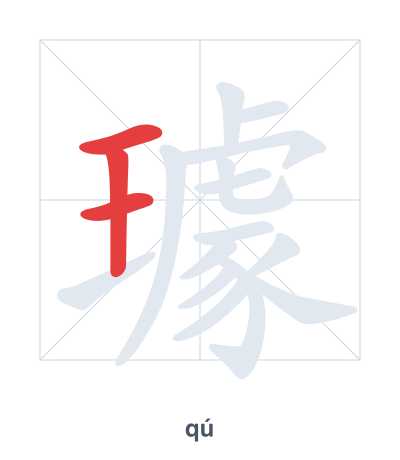
Open Hanzi Writer to see the animated stroke order and practice writing 璩 with real-time feedback.
The character 璩 (qú) is written with 17 strokes. Follow the standard Chinese stroke order: top to bottom, left to right, outside before inside. The radical 王 is one of its key components.
Practice the correct stroke order with the Hanzi Writer app to see animated stroke-by-stroke guidance with real-time feedback.
璩 means jade earring or a surname.
璩 is a phono-semantic compound: the radical 王 (jade) indicates it relates to jade, while the phonetic component 豦 (originally a pictograph of a beast fighting, composed of 虍 'tiger' and 豕 'pig') provides the sound qú. Together, they represent a jade earring worn in ancient times.
💡 Memory Tip: Picture a king (王) wearing a jade earring shaped like a pig (豕) being ambushed by a tiger (虍), symbolizing the fierce sound 'qú'.
璩先生正在开会。
qú xiān shēng zhèng zài kāi huì
Mr. Qu is in a meeting.
他戴着一个玉璩。
tā dài zhe yí gè yù qú
He is wearing a jade ring.
这个名字叫璩美。
zhè ge míng zì jiào qú měi
This name is Qu Mei.
Open Hanzi Writer to see the animated stroke order and practice writing 璩 with real-time feedback.
✨ Animated stroke order · Handwriting recognition · HSK-graded practice · Free to use
璩 is composed of the radical 王 (jade) on the left and the phonetic component 豦 on the right. The radical 王 indicates the character relates to jade or precious stones, while 豦 provides the pronunciation qú. Together, they form a character meaning jade earring or a surname.