劬 (qú) means "Toil; hard work" in Chinese. It has 7 strokes with the radical 力.
Rated 3.2/5 in difficulty (challenging).
Appears in 3+ common words including 劬劳 (qú láo), 劬苦 (qú kǔ), 劳劬 (láo qú).
Due to its 7 strokes, Hanzi Writer's error detection shows 劬 requires focused practice — most learners need 10+ attempts for consistent accuracy.
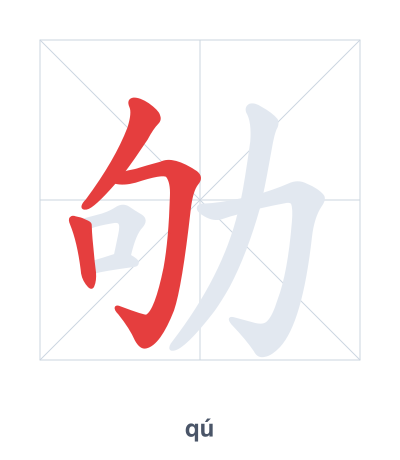
Open Hanzi Writer to see the animated stroke order and practice writing 劬 with real-time feedback.
The character 劬 (qú) is written with 7 strokes. Follow the standard Chinese stroke order: top to bottom, left to right, outside before inside. The radical 力 is one of its key components.
Practice the correct stroke order with the Hanzi Writer app to see animated stroke-by-stroke guidance with real-time feedback.
劬 means Toil; hard work.
This is a phono-semantic compound. The radical 力 (strength/work) conveys the meaning of toil and effort, while 句 (originally depicting a curved line or speech) provides the pronunciation qú. Together they suggest the exertion of force in repetitive or strenuous labor.
💡 Memory Tip: Imagine a worker bending over (句 looks like a hunched back) using all their strength (力) to push a heavy cart—that's pure toil.
父母劬劳一生。
fù mǔ qú láo yī shēng
Parents toiled hard throughout their lives.
农民耕作劬苦。
nóng mín gēng zuò qú kǔ
Farmers work hard at farming.
身体因劳劬而疲惫。
shēn tǐ yīn láo qú ér pí bèi
The body is exhausted from hard work.
Open Hanzi Writer to see the animated stroke order and practice writing 劬 with real-time feedback.
✨ Animated stroke order · Handwriting recognition · HSK-graded practice · Free to use
劬 is a left-right structure with 句 on the left and 力 on the right. The left part 句 gives the sound, while 力 means strength or effort, so together they convey the idea of hard work or toil.