祛 (qū) means "to dispel; to remove" in Chinese. It has 9 strokes with the radical 礻.
Rated 4/5 in difficulty (challenging).
Appears in 3+ common words including 祛痘 (qū dòu), 祛湿 (qū shī), 祛斑 (qū bān).
Due to its 9 strokes, Hanzi Writer's error detection shows 祛 requires focused practice — most learners need 10+ attempts for consistent accuracy.
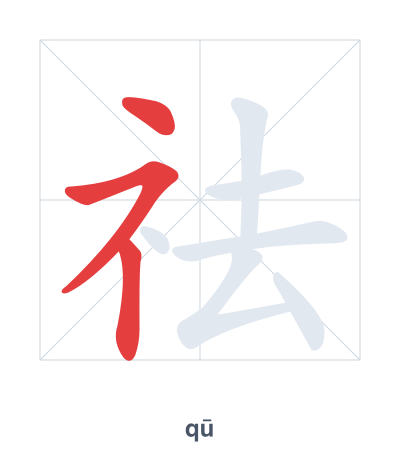
Open Hanzi Writer to see the animated stroke order and practice writing 祛 with real-time feedback.
The character 祛 (qū) is written with 9 strokes. Follow the standard Chinese stroke order: top to bottom, left to right, outside before inside. The radical 礻 is one of its key components.
Practice the correct stroke order with the Hanzi Writer app to see animated stroke-by-stroke guidance with real-time feedback.
祛 means to dispel; to remove.
The character 祛 combines the radical 礻 (spirit/altar) on the left with 去 (to go/depart) on the right. This visually represents using spiritual or ritual power to make something—like evil forces or illness—depart, hence 'to dispel' or 'to remove.'
💡 Memory Tip: Imagine a priest (礻) waving incense and shouting 'Go!' (去) to drive away a pesky ghost.
这种药膏可以祛痘。
zhè zhǒng yào gāo kě yǐ qū dòu
This ointment can remove acne.
喝红豆汤可以祛湿。
hē hóng dòu tāng kě yǐ qū shī
Drinking red bean soup can help remove dampness from the body.
她想买祛斑的产品。
tā xiǎng mǎi qū bān de chǎn pǐn
She wants to buy freckle-removing products.
Open Hanzi Writer to see the animated stroke order and practice writing 祛 with real-time feedback.
✨ Animated stroke order · Handwriting recognition · HSK-graded practice · Free to use
祛 is composed of the radical 礻 (meaning 'spirit' or 'altar') on the left, and the phonetic component 去 (qù, meaning 'to go') on the right. The radical suggests an action related to spirits or rituals, while 去 indicates the sound and the idea of 'removing' or 'sending away'. Together, they form the meaning of 'to dispel or remove' something, often negative influences or ailments.