俅 (qiú) means "Ornamental cap / Derung (ethnic group)" in Chinese. It has 9 strokes with the radical 亻.
Rated 3.7/5 in difficulty (challenging).
Appears in 3+ common words including 俅人 (qiú rén), 俅俅 (qiú qiú), 俅江 (qiú jiāng).
Due to its 9 strokes, Hanzi Writer's error detection shows 俅 requires focused practice — most learners need 10+ attempts for consistent accuracy.
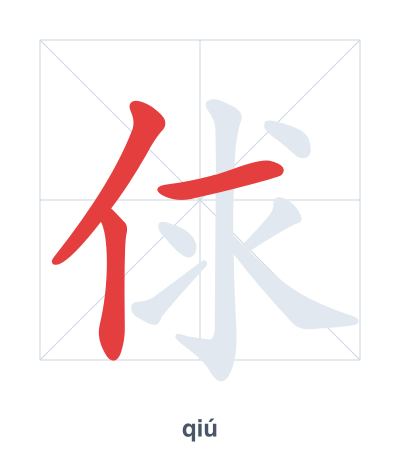
Open Hanzi Writer to see the animated stroke order and practice writing 俅 with real-time feedback.
The character 俅 (qiú) is written with 9 strokes. Follow the standard Chinese stroke order: top to bottom, left to right, outside before inside. The radical 亻 is one of its key components.
Practice the correct stroke order with the Hanzi Writer app to see animated stroke-by-stroke guidance with real-time feedback.
俅 means Ornamental cap / Derung (ethnic group).
俅 is a phono-semantic compound: the radical 亻 indicates a person, while 求 (qiú, 'to seek') provides the pronunciation. Its original meaning was an ornamental cap worn by ancient officials, later also used for the Derung ethnic group in China.
💡 Memory Tip: Imagine a person (亻) on a quest (求) to find a fancy ornamental cap to wear.
俅人是少数民族。
qiú rén shì shǎo shù mín zú
The Derung are an ethnic minority.
他的名字叫俅俅。
tā de míng zì jiào qiú qiú
His name is Qiuqiu.
俅江的水很清。
qiú jiāng de shuǐ hěn qīng
The water of the Qiujiang River is very clear.
Open Hanzi Writer to see the animated stroke order and practice writing 俅 with real-time feedback.
✨ Animated stroke order · Handwriting recognition · HSK-graded practice · Free to use
俅 is made of the radical 亻 (person) on the left and the component 求 (qiú) on the right. The person radical indicates the character relates to people, while 求 provides the pronunciation. The original meaning was a person wearing a ceremonial cap, linking the person radical to the idea of headwear.