阡 (qiān) means "path between fields" in Chinese. It has 5 strokes with the radical 阝.
Rated 2.7/5 in difficulty (moderate).
Appears in 2+ common words including 阡陌 (qiān mò), 阡 (qiān).
Hanzi Writer's stroke validation shows learners typically need 5-8 attempts to write 阡 with correct proportion and order.
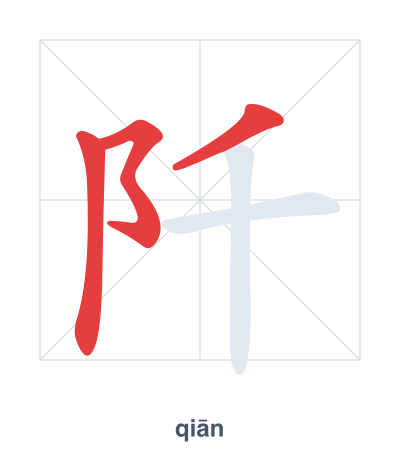
Open Hanzi Writer to see the animated stroke order and practice writing 阡 with real-time feedback.
The character 阡 (qiān) is written with 5 strokes. Follow the standard Chinese stroke order: top to bottom, left to right, outside before inside. The radical 阝 is one of its key components.
Practice the correct stroke order with the Hanzi Writer app to see animated stroke-by-stroke guidance with real-time feedback.
阡 means path between fields.
阡 combines the radical 阝 (a mound or hill, suggesting raised paths) with 千 (a phonetic component meaning 'thousand'), originally denoting a north-south path between fields, often along ridges or boundaries.
💡 Memory Tip: Imagine a thousand (千) little dirt paths winding between the fields, each marked by a little mound (阝) on the side.
这里的阡陌很整齐。
zhè lǐ de qiān mò hěn zhěng qí
The paths between the fields here are very neat.
阡是指田间小路。
qiān shì zhǐ tián jiān xiǎo lù
'Qiān' refers to a path between fields.
阡陌纵横。
qiān mò zòng héng
Paths cross each other in all directions.
Open Hanzi Writer to see the animated stroke order and practice writing 阡 with real-time feedback.
✨ Animated stroke order · Handwriting recognition · HSK-graded practice · Free to use
阡 is made of the radical 阝 (representing a mound or terrain) on the left and 千 (meaning thousand) on the right. The left component suggests a land feature, while 千 indicates many paths connecting fields. Together they convey the idea of countless small paths through farmland.