悭 (qiān) means "stingy; miserly" in Chinese. It has 10 strokes with the radical 忄.
Rated 4.2/5 in difficulty (advanced).
Appears in 3+ common words including 悭吝 (qiān lìn), 悭钱 (qiān qián), 悭吝鬼 (qiān lìn guǐ).
Due to its 10 strokes, Hanzi Writer's error detection shows 悭 requires focused practice — most learners need 10+ attempts for consistent accuracy.
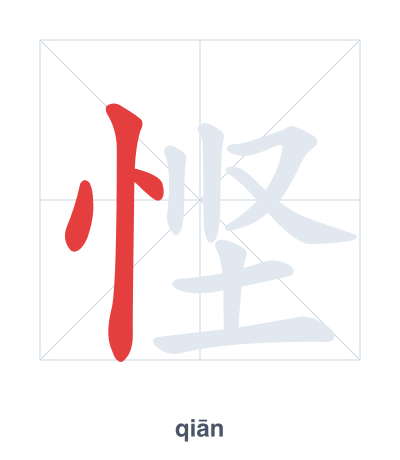
Open Hanzi Writer to see the animated stroke order and practice writing 悭 with real-time feedback.
The character 悭 (qiān) is written with 10 strokes. Follow the standard Chinese stroke order: top to bottom, left to right, outside before inside. The radical 忄 is one of its key components.
Practice the correct stroke order with the Hanzi Writer app to see animated stroke-by-stroke guidance with real-time feedback.
悭 means stingy; miserly.
The character 悭 combines the heart radical 忄 (xīn, related to feelings) with the phonetic component 坚 (jiān, meaning firm or hard). Together, they convey a heart that is hard and unyielding, reflecting a miserly nature unwilling to share or give.
💡 Memory Tip: Imagine a miser's heart (忄) is as hard as a rock (坚) — he squeezes every coin so tightly that nothing can pry them loose.
他这个人很悭吝。
tā zhè ge rén hěn qiān lìn
He is a very stingy person.
我们要学会悭钱。
wǒ men yào xué huì qiān qián
We should learn to save money.
别做一个悭吝鬼。
bié zuò yí gè qiān lìn guǐ
Don't be a miser.
Open Hanzi Writer to see the animated stroke order and practice writing 悭 with real-time feedback.
✨ Animated stroke order · Handwriting recognition · HSK-graded practice · Free to use
悭 is composed of the radical 忄 (heart/mind) on the left and 坚 (hard, firm) on the right. This suggests a "hard heart" — someone whose heart is firm and unyielding when it comes to sharing money, hence the meaning "stingy" or "miserly."