岵 (hù) means "Wooded hill" in Chinese. It has 8 strokes with the radical 山.
Rated 3.7/5 in difficulty (challenging).
Appears in 3+ common words including 岵山 (hù shān), 陟岵 (zhì hù), 岵屺 (hù qǐ).
Due to its 8 strokes, Hanzi Writer's error detection shows 岵 requires focused practice — most learners need 10+ attempts for consistent accuracy.
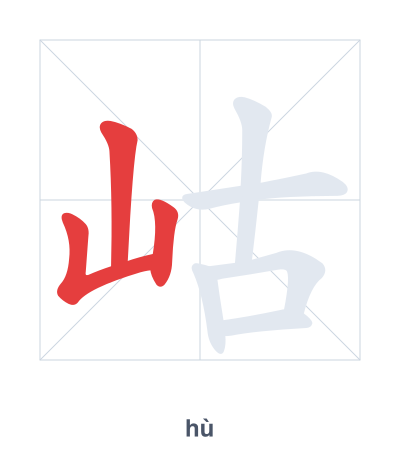
Open Hanzi Writer to see the animated stroke order and practice writing 岵 with real-time feedback.
The character 岵 (hù) is written with 8 strokes. Follow the standard Chinese stroke order: top to bottom, left to right, outside before inside. The radical 山 is one of its key components.
Practice the correct stroke order with the Hanzi Writer app to see animated stroke-by-stroke guidance with real-time feedback.
岵 means Wooded hill.
岵 is a phono-semantic compound where the radical 山 indicates 'hill' or 'mountain', and 古 (gǔ, 'ancient') provides the pronunciation while also hinting at an old, forested hill. The character appears in ancient poetry to describe a lush, wooded slope.
💡 Memory Tip: Picture an ancient (古) hill (山) so old and tall that it's completely covered in thick, wooden trees—a 'wooded hill'.
岵山上长满了树。
hù shān shàng zhǎng mǎn le shù
The wooded mountain is covered with trees.
陟岵表达思亲之情。
zhì hù biǎo dá sī qīn zhī qíng
'Zhihu' expresses the sentiment of missing one's parents.
岵屺常用来指代父母。
hù qǐ cháng yòng lái zhǐ dài fù mǔ
'Huqi' is often used as a metaphor for parents.
Open Hanzi Writer to see the animated stroke order and practice writing 岵 with real-time feedback.
✨ Animated stroke order · Handwriting recognition · HSK-graded practice · Free to use
The character 岵 consists of the radical 山 (mountain) on the left and the component 古 (gǔ, ancient) on the right. The mountain radical indicates a landform, while 古 provides the pronunciation and hints at the idea of an old, tree-covered hill. Together they create the meaning "wooded hill."