祺 (qí) means "Auspicious; blessing (often used in greetings)." in Chinese. It has 12 strokes with the radical 礻.
Rated 4.2/5 in difficulty (advanced).
Appears in 3+ common words including 台祺 (tái qí), 安祺 (ān qí), 祺祥 (qí xiáng).
Due to its 12 strokes, Hanzi Writer's error detection shows 祺 requires focused practice — most learners need 10+ attempts for consistent accuracy.
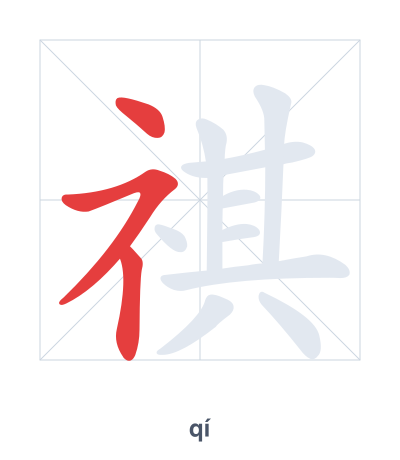
Open Hanzi Writer to see the animated stroke order and practice writing 祺 with real-time feedback.
The character 祺 (qí) is written with 12 strokes. Follow the standard Chinese stroke order: top to bottom, left to right, outside before inside. The radical 礻 is one of its key components.
Practice the correct stroke order with the Hanzi Writer app to see animated stroke-by-stroke guidance with real-time feedback.
祺 means Auspicious; blessing (often used in greetings)..
祺 is a compound character with the radical 礻 (示), meaning 'spirit' or 'divine', indicating blessings from the gods. The right side 其 (qí) provides the pronunciation and originally depicted a winnowing basket, but here it acts purely as a phonetic component. Together, the character conveys divine favor or auspiciousness, often used in greetings like 祺祥 (qíxiáng, 'good fortune').
💡 Memory Tip: Picture a spirit (礻) holding a lucky winning lottery ticket (其) — that’s an auspicious blessing!
顺颂台祺。
shùn sòng tái qí
Wishing you well (formal closing in letters).
祝你生活安祺。
zhù nǐ shēng huó ān qí
Wish you a peaceful life.
祝你祺祥如意。
zhù nǐ qí xiáng rú yì
Wish you auspiciousness and happiness.
Open Hanzi Writer to see the animated stroke order and practice writing 祺 with real-time feedback.
✨ Animated stroke order · Handwriting recognition · HSK-graded practice · Free to use
祺 is composed of the radical 礻 (meaning spirit or altar) on the left and the phonetic component 其 on the right. The radical 礻 connects the character to blessings and spiritual matters, while 其 provides the pronunciation qí, together creating the meaning of auspiciousness or blessing.