埼 (qí) means "headland / cape / peninsula" in Chinese. It has 11 strokes with the radical 土.
Rated 4.2/5 in difficulty (advanced).
Appears in 3+ common words including 埼玉 (qí yù), 埼岸 (qí àn), 埼角 (qí jiǎo).
Due to its 11 strokes, Hanzi Writer's error detection shows 埼 requires focused practice — most learners need 10+ attempts for consistent accuracy.
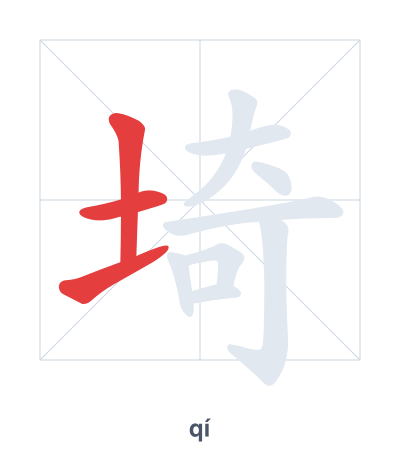
Open Hanzi Writer to see the animated stroke order and practice writing 埼 with real-time feedback.
The character 埼 (qí) is written with 11 strokes. Follow the standard Chinese stroke order: top to bottom, left to right, outside before inside. The radical 土 is one of its key components.
Practice the correct stroke order with the Hanzi Writer app to see animated stroke-by-stroke guidance with real-time feedback.
埼 means headland / cape / peninsula.
埼 is a phono-semantic compound: the radical 土 ('earth, land') indicates it refers to a landform, while the phonetic component 奇 (qí, meaning 'strange' or 'odd') supplies the pronunciation and suggests something protruding or unusual — together, they depict a cape or headland as an odd piece of land jutting into the sea.
💡 Memory Tip: Picture a strange (奇) lump of earth (土) sticking out into the ocean like a crooked finger — that's the cape called 埼.
他住在日本埼玉县。
tā zhù zài rì běn qí yù xiàn
He lives in Saitama Prefecture, Japan.
小船停在埼岸边。
xiǎo chuán tíng zài qí àn biān
The small boat is moored by the shore.
这里有一个小埼角。
zhè lǐ yǒu yí gè xiǎo qí jiǎo
There is a small cape here.
Open Hanzi Writer to see the animated stroke order and practice writing 埼 with real-time feedback.
✨ Animated stroke order · Handwriting recognition · HSK-graded practice · Free to use
The character 埼 is made of the radical 土 (earth) on the left and the phonetic component 奇 (qí, meaning strange) on the right. The radical 土 shows it is related to land or geography, which matches its meaning of "headland" or "cape." The right part 奇 provides the pronunciation qí.