桼 (qī) means "Lacquer (ancient form)" in Chinese. It has 11 strokes with the radical 木.
Rated 4.2/5 in difficulty (advanced).
Appears in 3+ common words including 桼树 (qī shù), 桼工 (qī gōng), 桼器 (qī qì).
Due to its 11 strokes, Hanzi Writer's error detection shows 桼 requires focused practice — most learners need 10+ attempts for consistent accuracy.
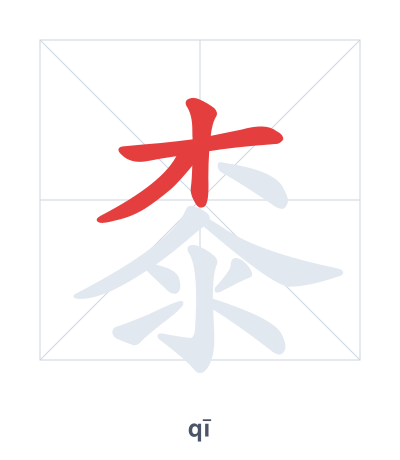
Open Hanzi Writer to see the animated stroke order and practice writing 桼 with real-time feedback.
The character 桼 (qī) is written with 11 strokes. Follow the standard Chinese stroke order: top to bottom, left to right, outside before inside. The radical 木 is one of its key components.
Practice the correct stroke order with the Hanzi Writer app to see animated stroke-by-stroke guidance with real-time feedback.
桼 means Lacquer (ancient form).
桼 shows a tree (木) with droplets of sap (the top strokes and the 㐁 component) dripping down, representing the raw sap of the lacquer tree. This ancient form later evolved into 漆 by adding the water radical (氵).
💡 Memory Tip: Picture a tree (木) with two drops of sticky lacquer dribbling down its trunk (the two small horizontal strokes and the vertical line), forming a gooey mess.
桼树可以产漆。
qī shù kě yǐ chǎn qī
Lacquer trees can produce lacquer.
他是一名桼工。
tā shì yī míng qī gōng
He is a lacquer worker.
这件桼器很漂亮。
zhè jiàn qī qì hěn piào liàng
This lacquerware is very beautiful.
Open Hanzi Writer to see the animated stroke order and practice writing 桼 with real-time feedback.
✨ Animated stroke order · Handwriting recognition · HSK-graded practice · Free to use
桼 is composed of 木 (tree) on top and 氺 (water) below. The tree component represents the lacquer tree, and the water component represents the sap that flows from it. Together they depict the lacquer sap coming from a tree.