掊 (póu) means "to dig or strike" in Chinese. It has 11 strokes with the radical 扌.
Rated 4.2/5 in difficulty (advanced).
Appears in 3+ common words including 掊击 (póu jī), 掊聚 (póu jù), 掊坑 (póu kēng).
Due to its 11 strokes, Hanzi Writer's error detection shows 掊 requires focused practice — most learners need 10+ attempts for consistent accuracy.
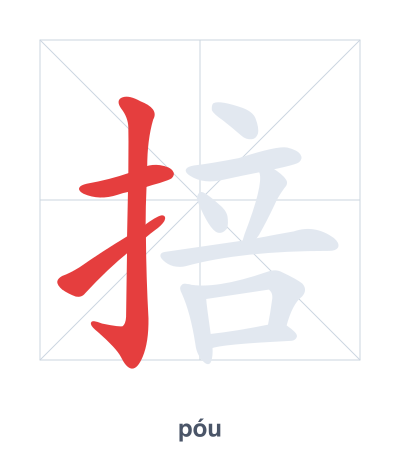
Open Hanzi Writer to see the animated stroke order and practice writing 掊 with real-time feedback.
The character 掊 (póu) is written with 11 strokes. Follow the standard Chinese stroke order: top to bottom, left to right, outside before inside. The radical 扌 is one of its key components.
Practice the correct stroke order with the Hanzi Writer app to see animated stroke-by-stroke guidance with real-time feedback.
掊 means to dig or strike.
掊 is a phono-semantic compound. The radical 扌 (hand) indicates an action performed with the hand. The component 咅 (pǒu), which originally depicted a hand breaking something apart, reinforces the meaning of striking or digging.
💡 Memory Tip: Picture your hand (扌) striking a standing figure (立) on the mouth (口) to dig them out of the ground.
他在文章中掊击对方。
tā zài wén zhāng zhōng póu jī duì fāng
He attacked the opponent in the article.
他在不断地掊聚钱财。
tā zài bù duàn dì póu jù qián cái
He is constantly amassing wealth.
他在地上掊了一个坑。
tā zài dì shàng póu le yí gè kēng
He dug a pit in the ground.
Open Hanzi Writer to see the animated stroke order and practice writing 掊 with real-time feedback.
✨ Animated stroke order · Handwriting recognition · HSK-graded practice · Free to use
The character 掊 combines the radical 扌 (hand) on the left with the phonetic component 咅 (pǒu) on the right. The hand radical indicates actions like digging or striking, while 咅 provides pronunciation. So 掊 literally means to use your hand to dig or hit.