胼 (pián) means "callus" in Chinese. It has 10 strokes with the radical 月.
Rated 4.2/5 in difficulty (advanced).
Appears in 3+ common words including 胼胝 (pián zhī), 胼手胝足 (pián shǒu zhī zú), 胼胝体 (pián zhī tǐ).
Due to its 10 strokes, Hanzi Writer's error detection shows 胼 requires focused practice — most learners need 10+ attempts for consistent accuracy.
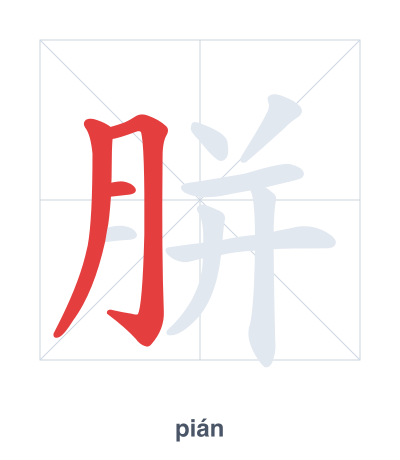
Open Hanzi Writer to see the animated stroke order and practice writing 胼 with real-time feedback.
The character 胼 (pián) is written with 10 strokes. Follow the standard Chinese stroke order: top to bottom, left to right, outside before inside. The radical 月 is one of its key components.
Practice the correct stroke order with the Hanzi Writer app to see animated stroke-by-stroke guidance with real-time feedback.
胼 means callus.
胼 is a phono-semantic compound. The radical 月 (flesh) indicates it relates to body tissue, while the component 并 (bìng, meaning 'combine' or 'side by side') hints at layers of skin pressing together to form a hardened callus.
💡 Memory Tip: Picture your fleshy (月) palm pressed together (并) so many times that a hard callus forms.
他的手上有胼胝。
tā de shǒu shàng yǒu pián zhī
He has calluses on his hands.
他们胼手胝足地工作。
tā men pián shǒu zhī zú dì gōng zuò
They worked with great toil.
脑部有胼胝体。
nǎo bù yǒu pián zhī tǐ
The brain has a corpus callosum.
Open Hanzi Writer to see the animated stroke order and practice writing 胼 with real-time feedback.
✨ Animated stroke order · Handwriting recognition · HSK-graded practice · Free to use
The left part is the radical 月, meaning flesh or body part, indicating the character relates to the body. The right part is 并, which gives the sound pián. Together, they form a character meaning callus, which is thickened skin on the body.