淠 (pì) means "Pi (name of a river)" in Chinese. It has 11 strokes with the radical 氵.
Rated 4.2/5 in difficulty (advanced).
Appears in 3+ common words including 淠河 (pì hé), 淠史杭 (pì shǐ háng), 淠淠 (pì pì).
Due to its 11 strokes, Hanzi Writer's error detection shows 淠 requires focused practice — most learners need 10+ attempts for consistent accuracy.
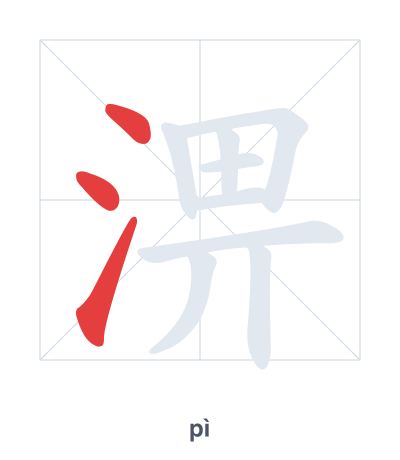
Open Hanzi Writer to see the animated stroke order and practice writing 淠 with real-time feedback.
The character 淠 (pì) is written with 11 strokes. Follow the standard Chinese stroke order: top to bottom, left to right, outside before inside. The radical 氵 is one of its key components.
Practice the correct stroke order with the Hanzi Writer app to see animated stroke-by-stroke guidance with real-time feedback.
淠 means Pi (name of a river).
淠 is a compound character with the water radical 氵 indicating it's a river, and the phonetic component 畀 (bì) providing the approximate sound (pì). The name refers specifically to the Pi River in ancient China.
💡 Memory Tip: Picture the Pi River (氵) flowing through a field (田) where a farmer gives (畀) water to the crops.
淠河在安徽省境内。
pì hé zài ān huī shěng jìng nèi
The Pi River is located within Anhui Province.
淠史杭是灌区名。
pì shǐ háng shì guàn qū míng
Pishihang is the name of an irrigation district.
旗帜淠淠地飘扬。
qí zhì pì pì dì piāo yáng
The flags are fluttering vigorously.
Open Hanzi Writer to see the animated stroke order and practice writing 淠 with real-time feedback.
✨ Animated stroke order · Handwriting recognition · HSK-graded practice · Free to use
淠 is a phonetic-semantic compound. The left part 氵 (water radical) indicates that the character is related to water, and the right part 畀 (bì, meaning 'to give') provides the pronunciation pì. Together, they form a character that means a specific river's name, the Pi River (淠河).