陴 (pí) means "parapet or low wall on a city wall" in Chinese. It has 10 strokes with the radical 阝.
Rated 3.9/5 in difficulty (challenging).
Appears in 3+ common words including 城陴 (chéng pí), 陴堄 (pí nì), 守陴 (shǒu pí).
Due to its 10 strokes, Hanzi Writer's error detection shows 陴 requires focused practice — most learners need 10+ attempts for consistent accuracy.
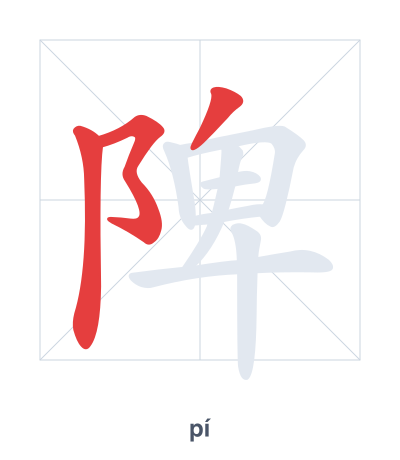
Open Hanzi Writer to see the animated stroke order and practice writing 陴 with real-time feedback.
The character 陴 (pí) is written with 10 strokes. Follow the standard Chinese stroke order: top to bottom, left to right, outside before inside. The radical 阝 is one of its key components.
Practice the correct stroke order with the Hanzi Writer app to see animated stroke-by-stroke guidance with real-time feedback.
陴 means parapet or low wall on a city wall.
The character 陴 combines the radical 阝 (a mound or hill) on the left with 卑 (meaning low or humble) on the right. It originally depicted a low protective wall built on top of a city's earthen rampart—a 'parapet' that is both elevated (阝) yet low in height (卑).
💡 Memory Tip: Imagine a soldier on a city mound (阝) crouching low (卑) behind a tiny wall to dodge arrows—that's the 陴 parapet.
古老的城陴很坚固。
gǔ lǎo de chéng pí hěn jiān gù
The ancient battlements are very solid.
士兵在陴堄后观察。
shì bīng zài pí nì hòu guān chá
The soldier is observing from behind the battlements.
战士们负责守陴。
zhàn shì men fù zé shǒu pí
The soldiers are responsible for guarding the city walls.
Open Hanzi Writer to see the animated stroke order and practice writing 陴 with real-time feedback.
✨ Animated stroke order · Handwriting recognition · HSK-graded practice · Free to use
陴 is made of the left radical 阝 (representing a mound or wall) and the right part 卑 (meaning low or humble). Together, they suggest a low wall on top of a city wall, which is exactly the meaning of parapet.