霈 (pèi) means "Torrential rain; heavy rain" in Chinese. It has 15 strokes with the radical 雨.
Rated 4.2/5 in difficulty (advanced).
Appears in 3+ common words including 霈然 (pèi rán), 霈泽 (pèi zé), 霈雨 (pèi yǔ).
Due to its 15 strokes, Hanzi Writer's error detection shows 霈 requires focused practice — most learners need 10+ attempts for consistent accuracy.
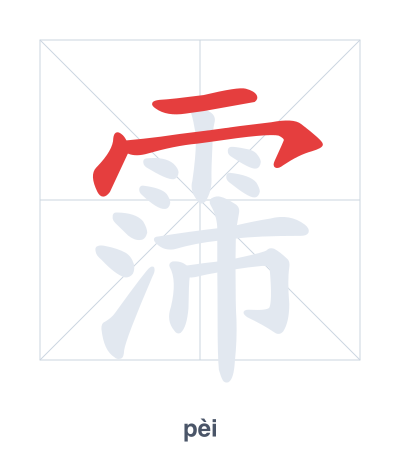
Open Hanzi Writer to see the animated stroke order and practice writing 霈 with real-time feedback.
The character 霈 (pèi) is written with 15 strokes. Follow the standard Chinese stroke order: top to bottom, left to right, outside before inside. The radical 雨 is one of its key components.
Practice the correct stroke order with the Hanzi Writer app to see animated stroke-by-stroke guidance with real-time feedback.
霈 means Torrential rain; heavy rain.
霈 is a compound character formed from the radical 雨 (rain) and the phonetic component 沛 (pèi), which originally meant 'abundant water' or 'torrent'. Together, 雨 indicates rain, and 沛 conveys the idea of copious flow, creating the meaning of a heavy downpour or torrential rain.
💡 Memory Tip: Imagine the rain (雨) is so fierce that it soaks a cloth (巾) completely, with water (氵) flooding everywhere—a torrential 'pei' storm.
霈然大雨落下来。
pèi rán dà yǔ là xià lái
Torrential rain poured down.
农民感谢这场霈泽。
nóng mín gǎn xiè zhè chǎng pèi zé
Farmers are grateful for this heavy rain.
霈雨滋润了庄稼。
pèi yǔ zī rùn le zhuāng jià
The heavy rain nourished the crops.
Open Hanzi Writer to see the animated stroke order and practice writing 霈 with real-time feedback.
✨ Animated stroke order · Handwriting recognition · HSK-graded practice · Free to use
The character 霈 has the radical 雨 (rain) on top, which directly indicates its connection to rain. The bottom part is 沛 (pèi), which is a phonetic component that also suggests abundance, together forming the meaning of heavy or torrential rain.