脬 (pāo) means "bladder; (measure word for urine or stool)" in Chinese. It has 11 strokes with the radical 月.
Rated 4.2/5 in difficulty (advanced).
Appears in 3+ common words including 尿脬 (suī pāo), 一脬尿 (yī pāo niào), 气脬 (qì pāo).
Due to its 11 strokes, Hanzi Writer's error detection shows 脬 requires focused practice — most learners need 10+ attempts for consistent accuracy.
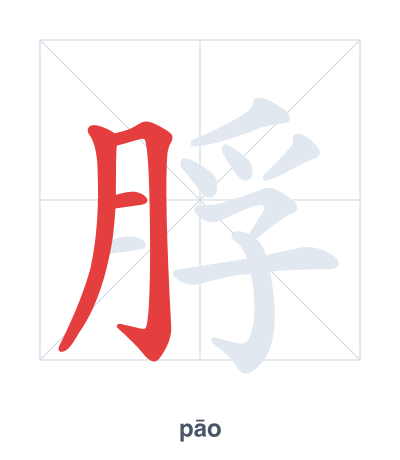
Open Hanzi Writer to see the animated stroke order and practice writing 脬 with real-time feedback.
The character 脬 (pāo) is written with 11 strokes. Follow the standard Chinese stroke order: top to bottom, left to right, outside before inside. The radical 月 is one of its key components.
Practice the correct stroke order with the Hanzi Writer app to see animated stroke-by-stroke guidance with real-time feedback.
脬 means bladder; (measure word for urine or stool).
This character is a phono-semantic compound. The radical 月 (flesh) indicates it is a body part, while 孚 (fú) provides the pronunciation. Together they refer to the bladder, the organ that stores urine.
💡 Memory Tip: Picture a fleshy (月) hand (爫) grasping a child (子) like the bladder holds onto urine.
他觉得尿脬很胀。
tā jué de suī pāo hěn zhàng
He felt his bladder was very full.
小狗撒了一脬尿。
xiǎo gǒu sā le yī pāo niào
The puppy took a pee.
鱼肚子里有气脬。
yú dǔ zi lǐ yǒu qì pāo
There is a swim bladder inside the fish's belly.
Open Hanzi Writer to see the animated stroke order and practice writing 脬 with real-time feedback.
✨ Animated stroke order · Handwriting recognition · HSK-graded practice · Free to use
脬 is composed of the radical 月 (meat/flesh) on the left, indicating it relates to a body part, and the phonetic component 孚 on the right, which hints at the pronunciation pāo. The bladder is a fleshy organ, so the 月 radical connects directly to its meaning.