逄 (páng) means "Pang (a surname)" in Chinese. It has 9 strokes with the radical 辶.
Rated 4/5 in difficulty (challenging).
Appears in 3+ common words including 逄先生 (páng xiān shēng), 姓逄 (xìng páng), 逄氏 (páng shì).
Due to its 9 strokes, Hanzi Writer's error detection shows 逄 requires focused practice — most learners need 10+ attempts for consistent accuracy.
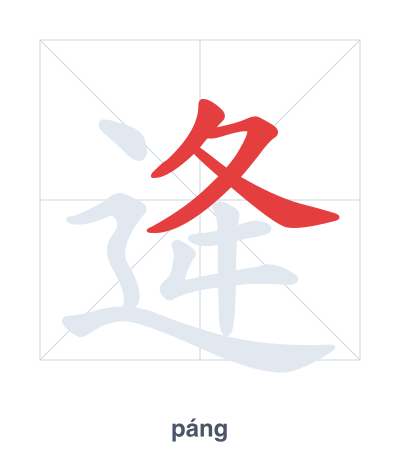
Open Hanzi Writer to see the animated stroke order and practice writing 逄 with real-time feedback.
The character 逄 (páng) is written with 9 strokes. Follow the standard Chinese stroke order: top to bottom, left to right, outside before inside. The radical 辶 is one of its key components.
Practice the correct stroke order with the Hanzi Writer app to see animated stroke-by-stroke guidance with real-time feedback.
逄 means Pang (a surname).
逄 is a compound character where the radical 辶 (walking) suggests movement, and the component 夆 (originally meaning 'to meet' or 'oppose') provides the sound and a subtle sense of encountering, though the character is primarily used as a surname (Pang). It shares its structure with 逢 (féng, 'to meet'), but has a different reading.
💡 Memory Tip: Picture a person walking (辶) and suddenly bumping into a fence made of two vertical bars (夆), letting out a loud 'PANG!'—that's the surname Pang.
逄先生是我的老师。
páng xiān shēng shì wǒ de lǎo shī
Mr. Pang is my teacher.
他姓逄,不姓庞。
tā xìng páng bù xìng páng
His surname is Pang (逄), not Pang (庞).
逄氏是一个古老的姓氏。
páng shì shì yí gè gǔ lǎo de xìng shì
Pang is an ancient surname.
Open Hanzi Writer to see the animated stroke order and practice writing 逄 with real-time feedback.
✨ Animated stroke order · Handwriting recognition · HSK-graded practice · Free to use
逄 consists of the radical 辶 (walk) on the left and the component 夆 on the right. The radical 辶 often relates to movement or paths, but the character's meaning as a surname has no direct connection to this. Instead, 夆 provides the sound páng and helps distinguish the character from others.