芽 (yá) means "Bud; sprout" in Chinese. It has 7 strokes with the radical 艹, and is HSK Level 7.
Rated 3.5/5 in difficulty (challenging).
Harder than 21% of HSK Level 7 characters.
Appears in 3+ common words including 发芽 (fā yá), 豆芽 (dòu yá), 嫩芽 (nèn yá).
Due to its 7 strokes, Hanzi Writer's error detection shows 芽 requires focused practice — most learners need 10+ attempts for consistent accuracy.
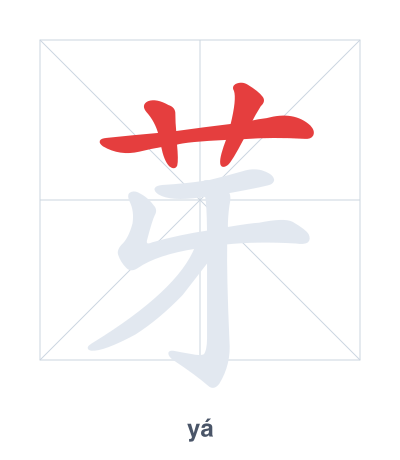
Open Hanzi Writer to see the animated stroke order and practice writing 芽 with real-time feedback.
The character 芽 (yá) is written with 7 strokes. Follow the standard Chinese stroke order: top to bottom, left to right, outside before inside. The radical 艹 is one of its key components.
Practice the correct stroke order with the Hanzi Writer app to see animated stroke-by-stroke guidance with real-time feedback.
芽 means Bud; sprout.
As an HSK Level 7 character, 芽 is an intermediate-level character.
芽 is a compound character formed from the grass radical 艹, indicating a plant, and 牙 (yá, 'tooth'), which both provides the pronunciation and suggests the shape of a tiny sprout pushing up like a tooth emerging from the ground.
💡 Memory Tip: Imagine a tiny green bud sprouting from the soil, shaped like a little tooth (牙) poking out of the grass (艹).
种子发芽了。
zhǒng zi fā yá le
The seed has sprouted.
豆芽很好吃。
dòu yá hěn hǎo chī
Bean sprouts are delicious.
树上长了嫩芽。
shù shàng zhǎng le nèn yá
Tender buds have grown on the tree.
Open Hanzi Writer to see the animated stroke order and practice writing 芽 with real-time feedback.
✨ Animated stroke order · Handwriting recognition · HSK-graded practice · Free to use
芽 is made of the radical 艹 (grass, plant) on top and 牙 (yá, tooth) below. The grass radical shows it is plant-related, while 牙 provides the sound and visually suggests a tiny tooth-like structure emerging from a plant, which is exactly what a bud or sprout looks like.