湃 (pài) means "Surging or splashing" in Chinese. It has 12 strokes with the radical 氵.
Rated 4.2/5 in difficulty (advanced).
Appears in 1+ common words including 澎湃 (pēng pài).
Due to its 12 strokes, Hanzi Writer's error detection shows 湃 requires focused practice — most learners need 10+ attempts for consistent accuracy.
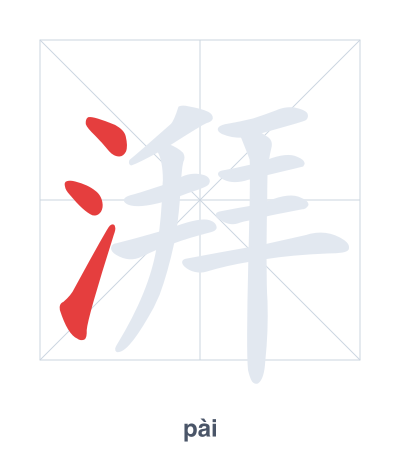
Open Hanzi Writer to see the animated stroke order and practice writing 湃 with real-time feedback.
The character 湃 (pài) is written with 12 strokes. Follow the standard Chinese stroke order: top to bottom, left to right, outside before inside. The radical 氵 is one of its key components.
Practice the correct stroke order with the Hanzi Writer app to see animated stroke-by-stroke guidance with real-time feedback.
湃 means Surging or splashing.
湃 combines the water radical 氵 (water) with 拜 (bài, to bow), which serves as a phonetic component hinting at the pronunciation pài. The water radical directly relates to the meaning of surging or splashing, while 拜 may visually suggest the rising and falling motion of waves like a bowing gesture.
💡 Memory Tip: Imagine a giant wave (氵) bowing (拜) as it surges forward, splashing everything in its path.
大海波涛澎湃。
dà hǎi bō tāo pēng pài
The sea waves are billowing.
他的心情很澎湃。
tā de xīn qíng hěn pēng pài
His emotions are surging.
音乐听起来很澎湃。
yīn yuè tīng qǐ lái hěn pēng pài
The music sounds very surging and powerful.
Open Hanzi Writer to see the animated stroke order and practice writing 湃 with real-time feedback.
✨ Animated stroke order · Handwriting recognition · HSK-graded practice · Free to use
湃 is composed of the water radical 氵 on the left and the character 拜 (bài, meaning 'to worship') on the right. The water radical gives the meaning of surging or splashing water, while 拜 provides a rough pronunciation clue (pài, though the tones differ). The combination suggests water moving with a forceful, worship-like energy.