澎 (pēng) means "to splash or surge" in Chinese. It has 15 strokes with the radical 氵.
Rated 4.2/5 in difficulty (advanced).
Appears in 3+ common words including 澎湃 (pēng pài), 澎湖 (pēng hú), 汹澎 (xiōng pēng).
Due to its 15 strokes, Hanzi Writer's error detection shows 澎 requires focused practice — most learners need 10+ attempts for consistent accuracy.
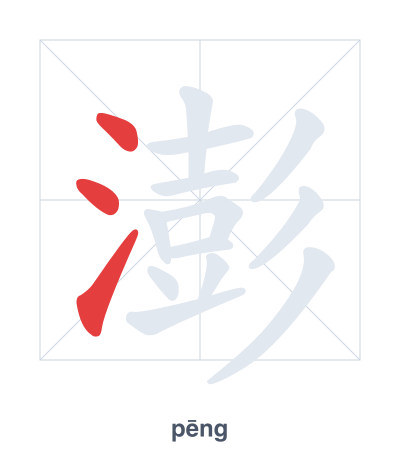
Open Hanzi Writer to see the animated stroke order and practice writing 澎 with real-time feedback.
The character 澎 (pēng) is written with 15 strokes. Follow the standard Chinese stroke order: top to bottom, left to right, outside before inside. The radical 氵 is one of its key components.
Practice the correct stroke order with the Hanzi Writer app to see animated stroke-by-stroke guidance with real-time feedback.
澎 means to splash or surge.
The character 澎 combines the water radical 氵 with 彭 (péng), which acts as a phonetic component and also hints at the sound or force of splashing. Together, they depict water surging or splashing forcefully, like waves crashing against rocks.
💡 Memory Tip: Picture a wave of water (氵) hitting a big drum (彭) with a loud 'PENG!' sound, sending splashes everywhere.
大海波涛澎湃。
dà hǎi bō tāo pēng pài
The sea waves are billowing.
澎湖是一个岛。
pēng hú shì yí gè dǎo
Penghu is an island.
波涛汹澎。
bō tāo xiōng pēng
The waves are surging and roaring.
Open Hanzi Writer to see the animated stroke order and practice writing 澎 with real-time feedback.
✨ Animated stroke order · Handwriting recognition · HSK-graded practice · Free to use
澎 is formed by the water radical 氵 on the left, which hints at water, and the phonetic component 彭 on the right. Together they create the meaning of water splashing or surging forcefully, like big waves.