搦 (nuò) means "to hold or provoke" in Chinese. It has 13 strokes with the radical 扌.
Rated 4.2/5 in difficulty (advanced).
Appears in 3+ common words including 搦管 (nuò guǎn), 搦战 (nuò zhàn), 搦住 (nuò zhù).
Due to its 13 strokes, Hanzi Writer's error detection shows 搦 requires focused practice — most learners need 10+ attempts for consistent accuracy.
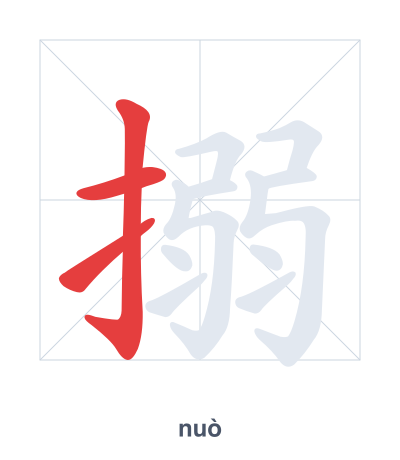
Open Hanzi Writer to see the animated stroke order and practice writing 搦 with real-time feedback.
The character 搦 (nuò) is written with 13 strokes. Follow the standard Chinese stroke order: top to bottom, left to right, outside before inside. The radical 扌 is one of its key components.
Practice the correct stroke order with the Hanzi Writer app to see animated stroke-by-stroke guidance with real-time feedback.
搦 means to hold or provoke.
搦 is a phono-semantic compound: the radical 扌 (hand) indicates that the character relates to an action of the hand, and 弱 (ruò, meaning weak) serves as a phonetic component, originally pronounced nuò in this context. The combination suggests a hand grasping something fragile or delicate, which evolved into the meanings 'to hold' and 'to provoke' (as in challenging a weaker opponent).
💡 Memory Tip: Imagine a hand (扌) poking a weak (弱) person to provoke them into a fight.
他搦管写下一首诗。
tā nuò guǎn xiě xià yī shǒu shī
He took up the pen and wrote a poem.
敌军在城门外搦战。
dí jūn zài chéng mén wài nuò zhàn
The enemy troops are challenging to a fight outside the city gate.
他紧紧搦住对方的手。
tā jǐn jǐn nuò zhù duì fāng de shǒu
He tightly gripped the other person's hand.
Open Hanzi Writer to see the animated stroke order and practice writing 搦 with real-time feedback.
✨ Animated stroke order · Handwriting recognition · HSK-graded practice · Free to use
The character 搦 combines the radical 扌 (hand) on the left with the phonetic component 弱 (ruò, meaning weak) on the right. The hand radical suggests an action, while 弱 adds the idea of forcing or challenging someone who is weak, linking to the meanings "to hold" or "to provoke."